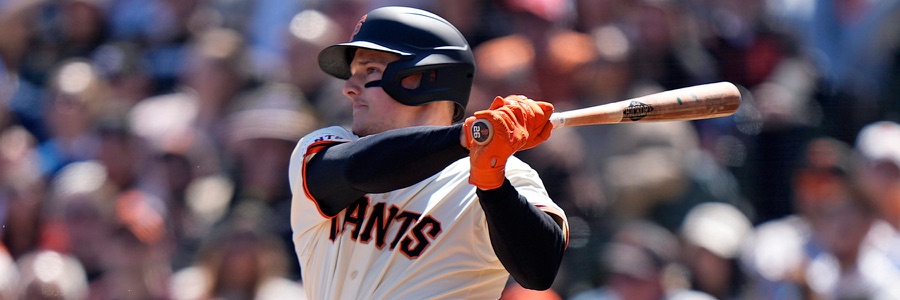
Remove Rafael Devers and the Giants are still 25th against left-handed pitching
San Francisco finished 28th of thirty in OPS against left-handed pitching. Subtract every plate appearance Rafael Devers took against a left-hander and the club is 25th, which means the man with the worst platoon split in baseball is not the reason his team has one.
Here is an experiment you can run at home, assuming your home contains a spreadsheet and a grudge.
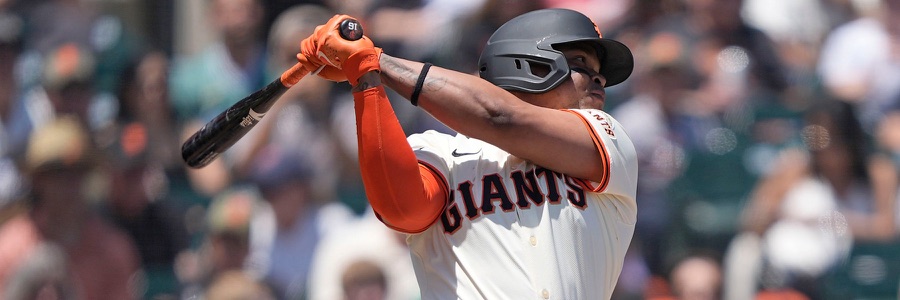
Start with the suspect. Rafael Devers hit left-handed pitching this season to the tune of a .573 OPS across 220 plate appearances. Against right-handed pitching he posted a 1.027 OPS across 413. The gap is 454 points, and it is the largest of any qualified left-handed hitter in Major League Baseball. Second place is not close: Alec Burleson of St. Louis at 382. Devers played his last game of the year on September 12.
So he is the guy. Obviously he is the guy. Take him out.
Subtract his 220 plate appearances from the 1,740 the Giants took against left-handed pitching, recompute the whole thing from the raw components, and San Francisco goes from a .669 OPS to a .684 OPS. The league median is .706. The club moves from 28th of thirty to 25th.
The suspect has an alibi, is what I am telling you. The room is still guilty.
What a platoon split is supposed to look like#
This is the number that makes every other number in this article readable, so here it is before anything else. Take all 135 hitters who qualified for the batting title in 2026 and compute each man's own OPS against left-handed pitching minus his OPS against right-handed pitching. The median left-handed hitter comes in at minus 88 points. The median right-handed hitter comes in at plus 36.
That is not a curiosity. That is the entire architecture of a lineup card. Left-handed hitters are worse against left-handed pitching, so you carry right-handed hitters, whose job on the days a left-hander starts is to be the reason you are not in trouble. Sixty-five of the 135 bat left-handed, 57 bat right-handed and the other thirteen switch, which is close enough to a balance that you can see the design in it.
One precision note, because it is easy to get backwards. League-wide, the aggregate OPS against left-handed pitching is .711 on 52,808 plate appearances and against right-handed pitching it is .723 on 124,298. Twelve points. That is not the platoon effect; that is the two effects cancelling, because both kinds of hitter are in both buckets. The per-hitter medians are the platoon effect.
San Francisco put three men on that list of 135. Devers at minus 454, Jung Hoo Lee at minus 162 on 178 and 401 plate appearances, and Willy Adames at minus 82 on 137 and 368.
Read that last one again.
The right-handed bat, whose entire job this was#
Adames is the club's primary right-handed hitter and his platoon split runs backwards. He was worse against left-handed pitching than against right-handed pitching, in a season where the median right-handed hitter was 36 points better.
Now the honest part, because the sentence above is the kind that gets written and then never checked. How unusual is a backwards split for a right-handed hitter? I went and counted: 18 of the 57 qualified right-handed hitters finished negative. Nearly a third of them. Adames ranks 8th worst among the 57. He is bad at the thing, not a freak of nature, and the piece that tells you otherwise is inflating.
What is genuinely absent is the other end. The right-handed hitters who actually punish left-handed pitching this year were Jo Adell at plus 388 on 174 plate appearances against left-handers, Chase Meidroth at plus 299 on 178, and Jake Burger at plus 254 on 163. No Giant is in that neighborhood, in the next neighborhood, or on the same bus route.
The two right-handed bats on the roster with a real sample and the normal shape are Matt Chapman, plus 104 on 95 and 257 plate appearances, and Casey Schmitt, plus 49 on 106 and 303. Against a median of plus 36, that is one man comfortably above the line and one man just over it. Both finished the season on the 60-day injured list.
The shape underneath, and the four clubs that share it#
The 40-man roster holds 18 position players: nine who bat right, nine who bat left, and nobody who switches. Add the sixteen men on the 60-day injured list, who do not count against the 40 today but will be back on it in the spring, and it becomes 24 position players, fourteen right and ten left, and still nobody who switches.
Before anyone builds a monument to that: I checked all thirty clubs the same morning, off the same roster endpoint, and four of them carry no switch-hitter at all. Houston with 21 position players, San Diego with 20, San Francisco with 18, Texas with 17. The median club has one or two. Fifty-eight of the 550 position players on major league rosters switch-hit. So it is uncommon, not unique, and anybody selling it as a Giants pathology is selling you Houston's too (and Texas's, and San Diego's, at a discount for volume).
The system holds seven switch-hitters among 125 position players across the seven affiliates, and I went and pulled all seven. Six of them hit worse against left-handed pitching than against right-handed pitching at every level they played in 2026, which is the wrong direction for this particular problem. The seventh is Dalton Wentz, who was better, on 19 plate appearances at High-A, which is not a finding. Josuar Gonzalez, the 18-year-old shortstop, is the tidiest illustration: .773 against left-handed pitching at Single-A San Jose, 1.116 against right-handed pitching. The switch-hitting is real. The half of it this organization needs is not the half that works.
Somebody in the system can do this, and he is very far away#
Yes, there is an answer. Lorenzo Meola is 22, a shortstop at Single-A San Jose, and he hit left-handed pitching for a 1.072 OPS across 139 plate appearances against a Single-A league average of .753 on 20,787 plate appearances. That is 319 points above his level. Exactly one right-handed bat in this system saw more left-handed pitching than he did, Sabin Ceballos with 152 plate appearances at Double-A Richmond, and Ceballos hit .762 against it, which is the Double-A average with a rounding error stapled to it. Dakota Jordan, 23, put up a .984 across 97 plate appearances at High-A Eugene, and Lisbel Diaz, 21, a .930 across 102 at the same level, both against a .756 baseline. Diaz then went to Double-A Richmond and hit .413 against left-handers across 32 plate appearances, which is a promotion doing what promotions do.
The two best Triple-A lines belong to Buddy Kennedy, 27, and Brett Harris, 28: a 1.131 OPS on 83 plate appearances and a 1.082 on 93. At those ages a Triple-A platoon number describes a role, not a future. Harris is already on the 40-man, claimed off waivers from Boston on September 3, and his major league work against left-handers this season runs to 19 plate appearances spread across three organizations.
The counterweight, which is real#
Two seasons ago this club finished 9th of thirty against left-handed pitching. In 2023 it was 28th, in 2024 it was 9th, in 2025 it was 30th and this year 28th. A team's handedness profile is not a personality trait, it is a roster, and rosters get rebuilt in December by men who have access to the same splits I do.
But 2025 and 2026 are the only two of those years that came back to back, and the thing that would fix it is not currently in the building. It is a 22-year-old shortstop in San Jose, three levels and at least two Novembers away from being anybody's answer to a left-hander at Oracle Park.
Sources#
All figures come from the MLB Stats API (statsapi.mlb.com), MLB's own feed, on the morning of September 21, 2026: the 40-man rosters of all thirty clubs, the 2026 platoon splits of every qualified hitter and every San Francisco position player, team-level splits for all thirty clubs in 2019 through 2026, the seven San Francisco affiliate rosters, league-wide OPS baselines by minor league level, and the league's transaction log for San Francisco, which is the source for Brett Harris's waiver claim. Team totals excluding Devers were recomputed from raw at-bats, hits, walks, hit-by-pitches, sacrifice flies and total bases rather than by averaging rates, and player totals for men who changed organizations use the feed's own multi-team line rather than a sum of its per-team rows, which the feed also returns.
Called Shot#
San Francisco finishes the 2027 regular season in the bottom ten of the thirty major league clubs in team OPS against left-handed pitching. Since 2019, 18 of the 35 clubs that finished a season in the bottom five against left-handed pitching were still in the bottom ten the following year, which is 51.4 percent and roughly a coin flip. San Francisco has finished 28th or worse in three of the last four seasons, its three best right-handed bats this year were one backwards split and two men who ended the season on the injured list, and the best right-handed answer in the system spent 2026 at Single-A. I will take a small lean over the base rate and not a large one.