Michigan owes the Big Ten a status for Andrew Sprague before it has a diagnosis
The conference's expanded availability rule gets its first reading on this team on Wednesday night. Kyle Whittingham said Monday morning he had no update on his starting right tackle. That night, on his own radio show, he said the range was this week to several weeks and that the medical staff was still working out what the injury is.
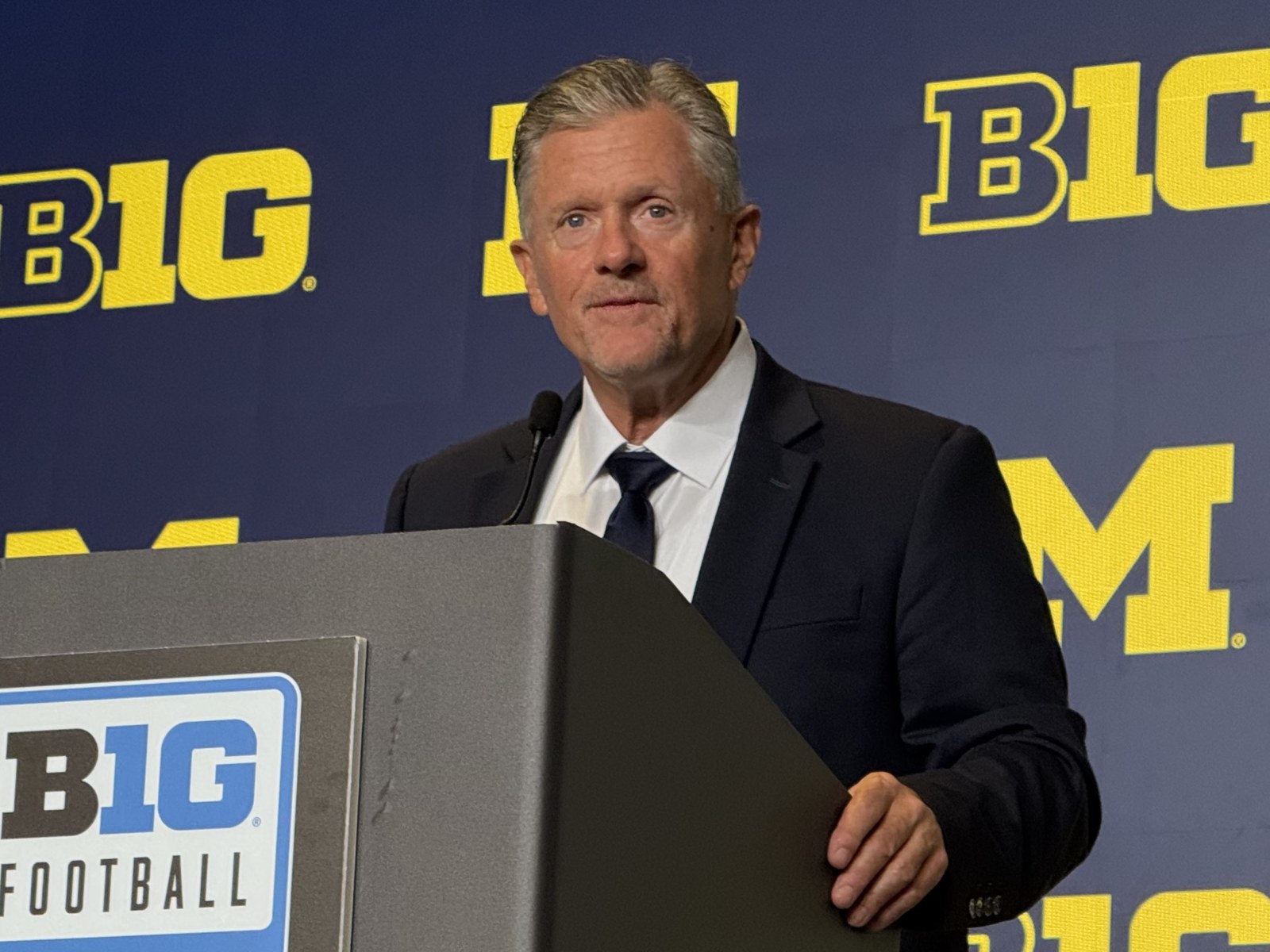
Kyle Whittingham had nothing on Monday morning.
Asked about Andrew Sprague, the junior right tackle who had missed Saturday's 52-17 win over UTEP, Michigan's head coach told his weekly press conference that there was no update, and that the staff hoped to know more later in the day. Von Lozon of Maize n Brew wrote it down that way. It is the sort of answer that expects to be replaced by a better one before dinner.
By Monday night he had replaced it, on his own radio show, and the replacement was worse.
"Andrew Sprague, gosh, that's a tough question," he said on Inside Michigan Football, quoted by Clayton Sayfie of On3, when he was asked for a timeline. "I think it could be anywhere from this week to several weeks, so we just don't know. And that's what we're trying to sort through that, not we, but the medical staff, making sure we get the exact diagnosis to treat this thing the right way."
Sprague told Whittingham late on the Friday before the UTEP game that he could not go. Big Ten Network described the injury as undisclosed. By Monday night, three days on, Michigan did not have a name for it.
On Wednesday at 8 p.m. Eastern, Michigan has to pick a word for it anyway.
The form#
The Big Ten expanded its football availability reporting on August 28. Schools now file four reports a week instead of one. The release sets the deadlines at 8 p.m. Eastern three days before kickoff, again two days before, again one day before, and a final submission two hours before the game starts, and it wrote the example into the text in case anybody wanted to argue about the arithmetic: "three days (e.g., on Wednesday for a Saturday game)."
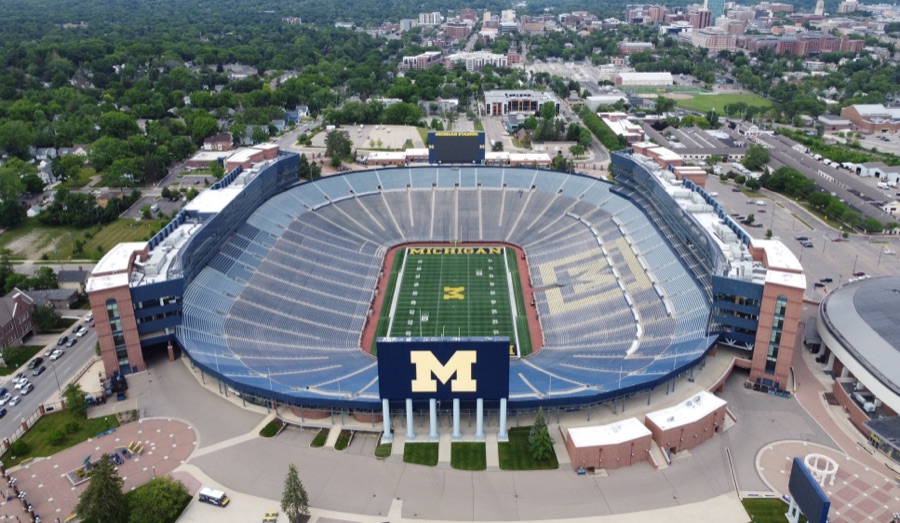
Michigan plays Iowa at 3:30 p.m. Eastern on Saturday at Michigan Stadium, on CBS. Iowa is ranked 17th in this week's Associated Press poll and Michigan is 18th. So the first deadline is Wednesday night, and the conference's own availability page agrees: the card for the 3:30 game in Ann Arbor currently reads REPORT PENDING 9/23/26.
The midweek vocabulary has five entries: Probable, Questionable, Doubtful, Out and Out (1st Half). On game day it narrows to three: Game Time Decision, Out, Out (1st Half). Anybody a school leaves off the list is available, which the release states rather than implies. "Student-athletes not listed on a report are considered Available."
That is the entire language. Five on Wednesday, three on Saturday, and a default for silence.
Now look at what the form does not ask. Open the table the conference publishes and the columns run team, date, opponent, number, player, and then four status columns, one for each filing. There is no field for what is wrong with anybody. The Big Ten built an instrument that records whether a player can play and declines to record why.
That is a defensible thing for a conference to build. It is an awkward thing for a school that does not currently know the answer to either question. Michigan will file a status on Wednesday for a player it cannot diagnose, and those are two different problems. Only one of them has a deadline.
One week of evidence, and it is one week#
The rule is new enough that its entire history fits on a single page. The first reports of the Big Ten season were due before the two conference games played on September 19, USC at Rutgers and Purdue at UCLA. The conference has published what those four schools filed, all four submissions each, which makes this the only sample anybody has.
Thirty-nine players appear across the four reports. That is the denominator for every number below. USC listed 14, UCLA 11, Rutgers 9, Purdue 5.
Eighteen of the 39 were listed Out in the first Wednesday filing. By kickoff, 29 were Out.
The useful version of that is the other way round. Twenty-one players went into Wednesday with their status still open, meaning anything other than Out. Eleven of those 21 were Out by Saturday. Five got better, finishing Available. Five went to kickoff as Game Time Decisions.
So a little more than half of the genuinely open cases closed badly inside three days, on a sample of 21, from one week, from four teams, none of which is Michigan. Take it for what it is worth, which is something and not much.
The sharpest single row is USC's. Four of its players carry an initial status of Available in the conference's published table, and all four are Out by game day. A school put four men in writing as fine on Wednesday and crossed them off by Saturday.
Wednesday's word, then, is a Wednesday word. It is worth having and it is not a diagnosis, which is convenient, because a diagnosis is the thing Michigan says it does not have.
The five men who have to block Iowa#
The football underneath the paperwork is that Michigan has already played a game without Sprague and played it well, and that the game was against UTEP.
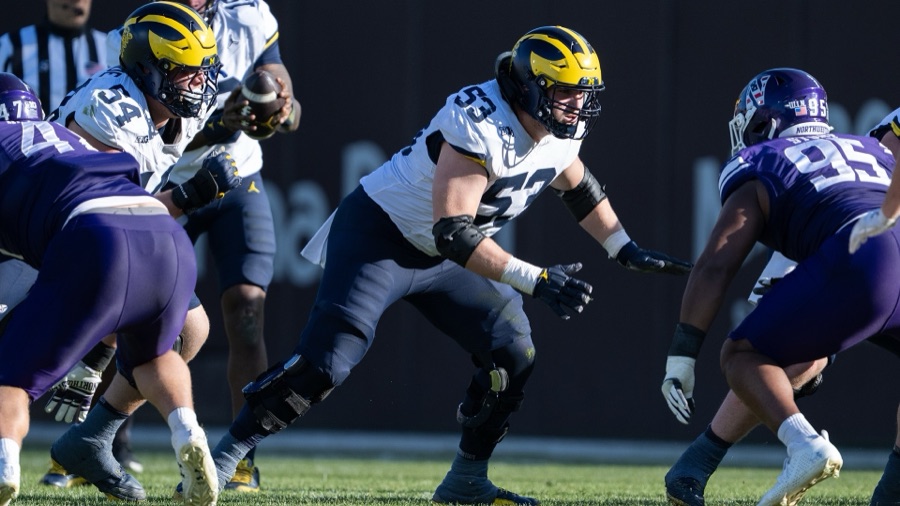
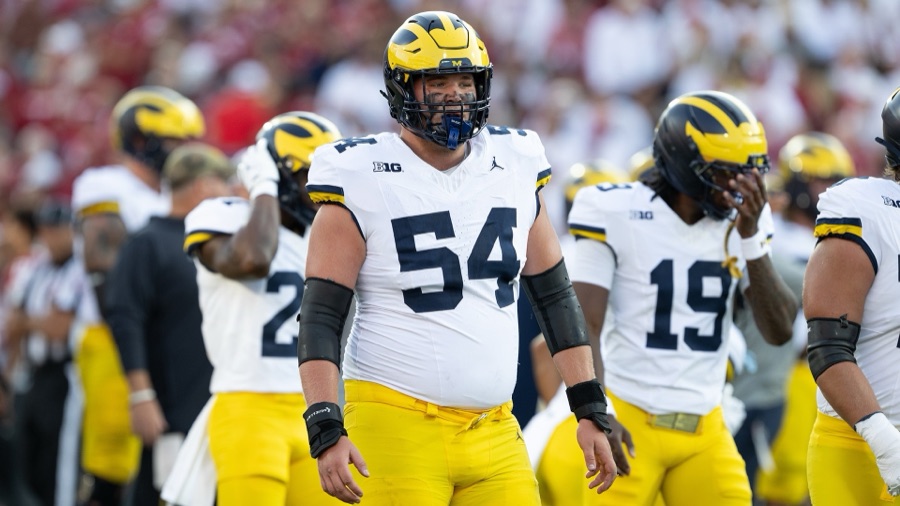
When Sprague went out on Friday night, Michigan moved Blake Frazier from left tackle to right tackle, kicked Evan Link out from left guard to tackle, and started Nathan Efobi at left guard. One injury, three jobs changed. Whittingham said the group had not practiced that way once.
"We had zero reps during the week with that configuration because we didn't find out about Andrew until late on Friday, and all the preparation was over as far as practice time," he said on the radio show. He credited offensive line coach Jim Harding by name, and he pointed out that Link had played a good deal of left tackle last season, so the move was less foreign than it sounded.
Michigan ran for 185 yards at 4.4 a carry behind that line and allowed one sack. Whittingham called the grades "pretty darn good" at Monday's press conference.
UTEP is the reason to keep that in proportion rather than the reason to relax. Michigan won by 35. The opponent on Saturday is ranked 17th and does not want the game to look anything like that one, which Whittingham described himself when he was asked whether it would be a defensive afternoon: "That's how they'd like it, that's their MO. They shorten the game and beat you with defense and win in the end."
There is one more name on the Wednesday form worth watching. Jordan Marshall has been playing through a lower-body injury that has slowed him since early in the season, and he has 34 carries for 135 yards and two touchdowns through three games. Whittingham's version of his status is the exact phrasing the availability report was built to convert into a single word.
"Jordan will be available, unless there's a setback during the course of the week."
Wednesday at eight.
The calls#
Two, both scored off documents anybody can open at bigten.org, and one piece of unfinished business.
First: Andrew Sprague's status on Michigan's game-day availability report for Saturday's game is Out or Out (1st Half). The case for it is that the injury arrived on a Friday, was still undiagnosed on the Monday night three days later, and the head coach reached for "several weeks" without being pushed. The case against it is that he put "this week" first in the same sentence, and coaches who expect bad news rarely lead with the good half.
Second: at least one Michigan player other than Sprague finishes the week with a game-day status of Out or Out (1st Half) after starting it as something else. That is the shape the first week of this rule produced 11 times in 21 chances, and Marshall's "unless there's a setback" is the sentence it usually starts with. If the Big Ten does not publish Michigan's report with both an initial and a game-day column, this resolves no.
And the unfinished business, because a ledger that only records the wins is a scrapbook. The call made here on September 1 was that Whittingham would name at least one unavailable Michigan player on the record before the Oklahoma game, when no rule obliged him to say anything. He did not, and that call was graded wrong on September 13. The argument behind it was that this head coach withholds assignments and volunteers availability. Monday complicated it in both directions: he volunteered nothing at the podium in the morning and a great deal on his own radio show at night. The rule that starts on Wednesday does not care which venue he prefers, which is rather the point of having it.
Sources: Clayton Sayfie, On3 (The Wolverine), September 21, 2026, for every Whittingham quotation from the Inside Michigan Football radio show, for the offensive line configuration against UTEP, for the 185 rushing yards, 4.4 yards per carry and one sack allowed, for Big Ten Network's "undisclosed" description, and for Jordan Marshall's season line and availability quotation. Von Lozon, Maize n Brew, September 21, 2026, for the Monday morning press conference, including the absence of a Sprague update, the hope of knowing more later that day, the Iowa defensive-style quotation and the offensive line grades. Big Ten Conference, "Big Ten Announces Changes To Football Availability Reporting Process," August 28, 2026, read at bigten.org, for the four-report schedule, the 8 p.m. Eastern deadlines, the Wednesday-for-Saturday example, the five midweek designations, the three game-day designations, the default to Available and the conference-only scope. The Big Ten's 2026 Football Availability Reports page at bigten.org, read live on September 22, 2026, for the REPORT PENDING 9/23/26 card on the Ann Arbor game and for the published archive of the September 19 reports, from which the 39 players, the four team totals, the 18 initial and 29 game-day Out designations, the 21 open cases, the 11 that closed as Out, the five that finished Available, the five Game Time Decisions and the four USC players listed Available and ruled out were counted directly. CollegeFootballData, read September 22, 2026, for the UTEP result, the Iowa kickoff date and time and the Associated Press poll positions of Iowa and Michigan.