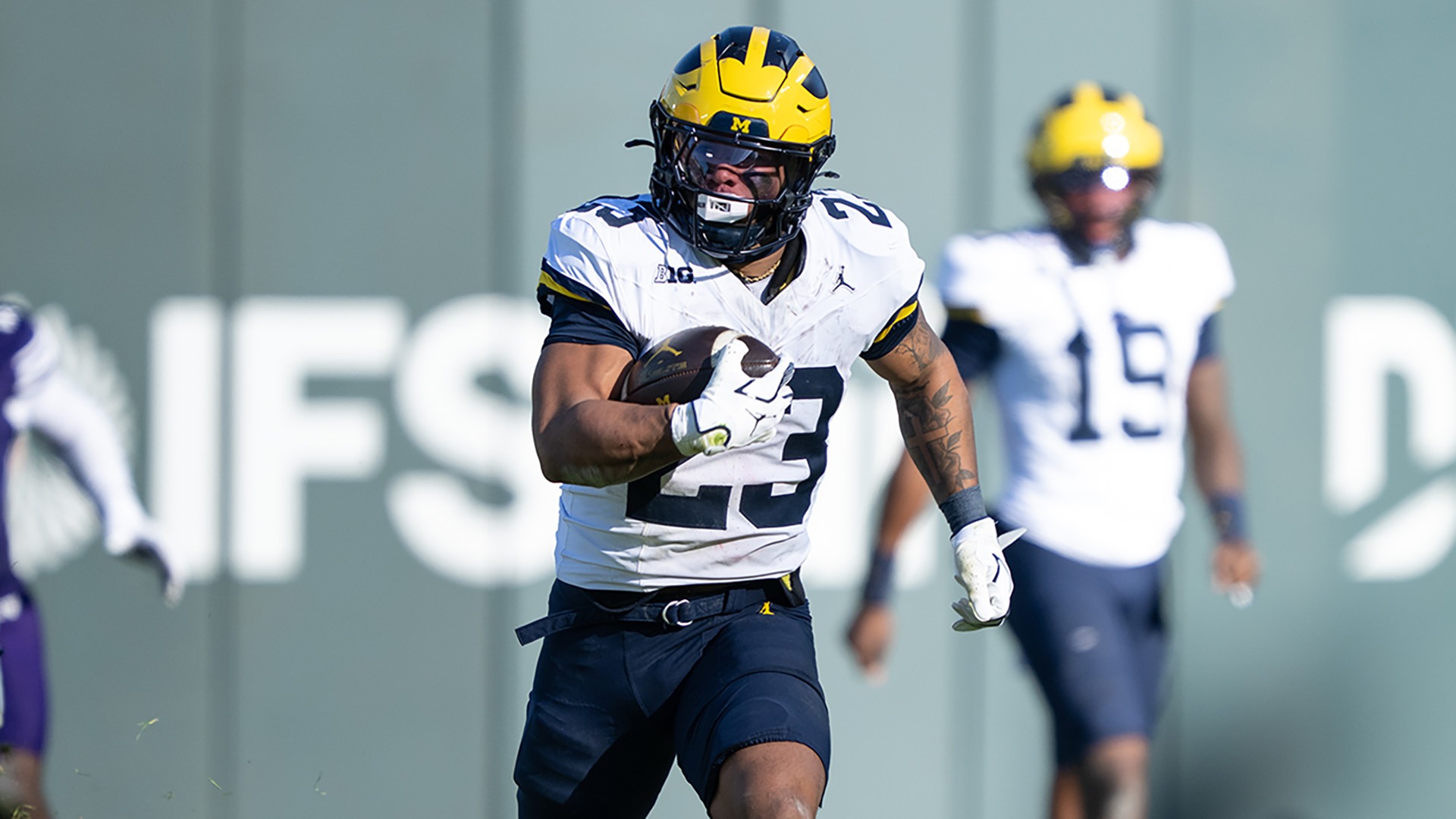
Does the Big Ten's $49 million line bind Michigan? Its own budget can't say
The Big Ten's new limit is one number per school, shared by every sport, measured on the 2027-28 year. Michigan publishes its revenue sharing, $21.32 million, and not the money from its boosters and collective, which is what decides whether the line binds.
The Big Ten's new limit on athlete money is $49 million. It is not a cap on what a Michigan football player can earn. It is not a football number at all. It is one figure per school, for every sport that school sponsors, and it counts three kinds of money: what the school pays its athletes, what its boosters and collectives pay them, and deals the school helps arrange.
The conference's presidents and chancellors approved the rule on October 28, and Section 1 of the three-page rule does the work. A member school may not help arrange any NIL deal (NIL is name, image and likeness: an athlete paid for endorsements and appearances) if that deal would push the sum of three things past $49 million for the 2027-28 cap year:
- the school's direct revenue-sharing payments to all of its athletes under the House settlement, the court settlement that let schools pay athletes directly;
- every NIL deal between its athletes and an "associated entity or associated individual," the NCAA's term for the school's boosters and collectives, as the College Sports Commission (the settlement's enforcement body) determines them;
- the deal the school is about to help arrange.
The rule binds the school, not the athlete. The release says athletes "remain free to pursue NIL opportunities" with any company or booster on their own. A booster deal an athlete signs alone is still counted, so it uses up room the school would otherwise have to arrange deals. Two kinds of money sit outside the count entirely. An athlete who finds their own deal with a company that has no tie to the school is untouched. And deals with a school's official apparel partner are excluded, provided the school, the company and the athlete all sign a form saying the school did not arrange the deal.
The Big Ten's own arithmetic in the release: $27.5 million for school-arranged third-party deals, on top of the revenue-sharing payments the settlement already allows, totaling $49 million. The number copies the Protect College Sports Act's structure before Congress has passed it. The rule's background section lays it out: the settlement's revenue-sharing pool, which the Big Ten puts at $21.58 million for 2026-27, plus a $22.5 million retention pool and a further $5 million tied to spending on non-revenue sports, about $49.08 million in all.
What Michigan publishes#
Michigan is a public university, and its athletic department puts its budget in front of the Board of Regents each June.
The FY 2027 budget the department presented on June 25 carries a line called "Student-athlete revenue sharing." It reads $21.32 million. Against the $21.58 million ceiling the Big Ten cites for this academic year, that is $260,000 short. The College Sports Commission's own revenue-sharing page still describes the 2026-27 cap as an estimate of "approximately $21.3 million," the figure Michigan's June budget matches.
The same regents document lists 2025-26 revenue sharing at $20.5 million budgeted, which was the full settlement ceiling for that year, and $18.0 million projected. If the projection held, Michigan paid its athletes $2.5 million less than it was allowed to in the first year schools could pay them directly.
That line is every sport. Michigan does not publish how its revenue-sharing money splits between football, basketball and its other teams, and neither the budget nor the release gives a football share.
What Michigan does not publish#
The second layer decides whether $49 million binds. Deals between athletes and a school's boosters and collectives do not appear in the athletic department's budget. The College Sports Commission reviews them, and the rule says the Big Ten will ask the commission for that data to enforce the cap. None of it is public by school.
The closest public figure for Michigan football is a valuation, not a payroll. In May, OutKick published estimates compiled by a group called College Front Office for 68 power-conference rosters. It put Michigan's football roster at $32.4 million, 15th on its list, with Ohio State at $43.5 million and Texas first at $47.9 million. OutKick's own caveat is that the numbers value the players "and not necessarily what these teams and their collectives actually spent." It also counts football alone.
So the comparison that holds is narrower than $49 million invites. Subtracting $32.4 million from $49 million produces nothing useful: one figure is a football valuation and the other is an all-sports limit on a specific kind of money. If Michigan spends to the full revenue-sharing ceiling, every dollar its collective and boosters put into athletes across all sports, plus every deal the department helps arrange, has to fit inside what is left of $49 million. On the 2026-27 ceiling, that is $27.42 million, which the Big Ten rounds to $27.5 million.
When it starts to matter#
The release calls the rule "effective immediately," and the rule's text sets its measurement on the 2027-28 cap year. The two fit together through Section 4: any third-party money going to athletes who enroll at a school for the first time in 2027 counts against the 2027-28 total. That is the class Michigan signs to enroll in 2027 and anyone it adds from the transfer portal for next season. The release says the timing is meant to steer schools "in advance of upcoming signing and transfer portal windows."
Section 5 closes the obvious workaround. Each school's president, athletic director, head and position coaches and general managers must attest that they did not rewrite any 2026-27 agreement with an athlete to get around the rule. Paying next year's money early, under a contract for this year, would put a false attestation over the signatures of the people who arranged it.
One more clause matters to any athlete whose eligibility is in dispute. Money paid under a covered deal counts toward the $49 million "even if the student-athlete party to such agreement has been determined to be ineligible in any respect."
Whether Congress changes it#
It does not, yet. The Senate passed the Protect College Sports Act 77-22 on September 28, and the bill now sits with the House. The Big Ten's rule is written under authority the House settlement already gives conferences, and it stands whether or not the bill passes.
Sources: Big Ten Conference, "Big Ten Prepares for Protect College Sports Act Economic Framework," October 28, 2026, and the linked "Full Big Ten Rule" PDF, for the October 28 approval, the $49 million and $27.5 million figures, the $21.58 million, $22.5 million and $5 million pools, every rule section quoted or described, the effective date and the quoted language. University of Michigan Regents, supplemental agenda for June 25, 2026, Athletic Department FY 2027 Operating Budget, for the $21.32 million, $20.5 million and $18.0 million revenue-sharing lines. MGoBlue.com, "Michigan Athletics Projects Balanced Budget for FY 2027," June 25, 2026. College Sports Commission, Revenue Sharing page, for the "approximately $21.3 million" estimate. OutKick (Fox News), "Which teams have the most valuable college football rosters heading into 2026 season?", May 13, 2026, for the College Front Office valuations and the quoted caveat. FOX 9, September 29, 2026, for the Senate's 77-22 vote and the bill's referral to the House.