Rutgers stopped Michigan on first down, and third down covered for it
Michigan ran 21 times on first down at Rutgers for 59 yards, its worst first-down rate of the season against a defense that had allowed 5.8 a carry. It won on later downs, including a run of long third downs it had not managed all year.
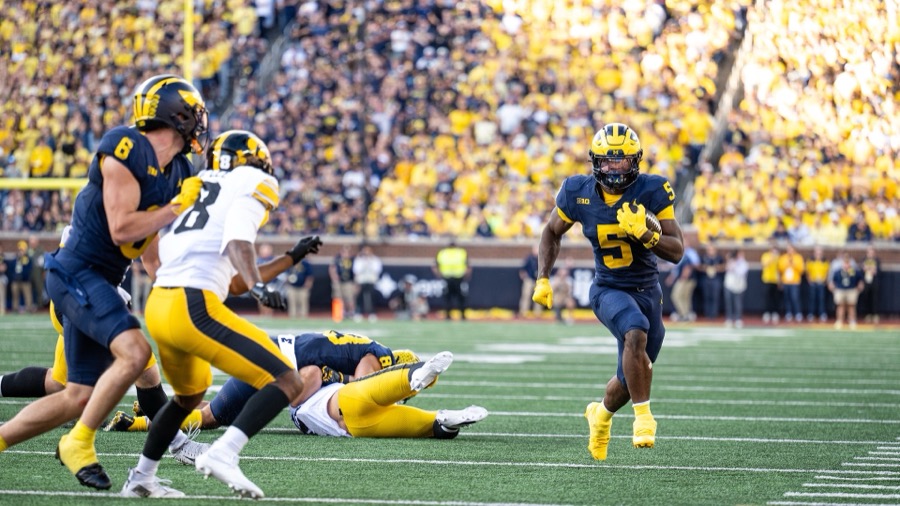
Michigan ran the ball on first down 21 times at Rutgers on Saturday and gained 59 yards, 2.8 a carry. That is the lowest first-down rushing average of Michigan's eight games, by CollegeFootballData's play-by-play, and it came against the defense on the schedule that had been easiest to run on: Rutgers entered the game having allowed 1,394 yards on 239 carries, 5.8 a carry, per CollegeFootballData's season statistics.
Before halftime it was worse. Michigan ran on first down nine times in the first two quarters and gained 10 yards. Three of those runs gained nothing or lost ground, and one of the nine was a 2-yard touchdown from first-and-goal at the 2.
Michigan won 28-21 anyway, and it did so on the downs that came after. The headline number was third down, 12 of 16. What third down was covering for is the part worth tracing, because the conversions that covered for it are the least repeatable thing Michigan did all day.
Where first down went#
The 21 runs exclude Tommy Carr's kneel-down at the end and a fourth-quarter first-down snap the play-by-play logs as a fumble, which lost 4 yards and which Michigan recovered. Counting that one would lower the average.
Set against Michigan's own season, the Rutgers number stands alone. In its other seven games Michigan ran 113 times on first down for 495 yards, 4.4 a carry. It averaged 4.0 or better on first-down runs four times, with Penn State the high at 6.7, and its three games under 4.0 before Saturday were Oklahoma, Minnesota and Indiana, at 3.4, 3.5 and 3.6. Rutgers produced the lowest figure of all.
The first-half runs went Jordan Marshall 3 and 1, Savion Hiter 2 and 1, Bryson Kuzdzal no gain, Carr no gain, Hiter 5, Marshall's touchdown, and Marshall for a 4-yard loss at the Rutgers 38. Eight of the nine went up the middle by the play-by-play's direction label.
First-down throws were a different story. Carr threw on first down six times in the first half, completing all five passes he got off for 48 yards and taking one 9-yard sack. After halftime Michigan threw on first down twice, a 4-yard completion to Hiter and an incompletion that drew pass interference. Every other second-half first down was a run or the kneel-down, and the 12 runs did better than the first half's had: 49 yards, 4.1 a carry.
So the first-half pattern was this: Michigan's first-down throws worked, its first-down runs did not, and it kept calling the runs.
What second and third down had to carry#
Michigan ran 26 plays on second down for 200 yards, 7.7 a play, its second-best second-down average of the season behind Iowa. Two throws did a lot of it: Salesi Moa's 44-yard catch on second-and-8 on the opening drive and Mason Bonner's 27-yard catch on second-and-10 in the final minute of the first quarter. Without those two, the other 24 second-down plays gained 129 yards, 5.4 a play, which is still good football.
Third down is where the game was won, and the distances are why it should not be expected again. Michigan faced eight third downs of 6 yards or more in regulation at Rutgers and converted six. In its first seven games it faced 40 of those and converted 14, which is 35%. No previous game had produced more than three conversions at that distance.
A team that starts drives behind schedule needs long third downs to go its way. Michigan's 12 of 16 was its best third-down rate of the season, ahead of UTEP's 9 of 13. Across the other six games Michigan converted between 3 of 10 and 7 of 18 in regulation.
Carr produced five of the six long conversions himself: three completions and the two touchdown runs, 15 yards on third-and-6 and 9 yards on third-and-7. Kuzdzal ran for the other. That is a real thing a first-year starter did on the road. It is also the kind of output that one game cannot tell you he will repeat, and Michigan's own record says how rare it has been.
Rutgers got nine possessions#
The other half of the arithmetic is on the other side of the ball. By CollegeFootballData's drive file, Rutgers had the ball nine times. No Michigan opponent this season had fewer than 11. The game had 19 possessions in all, the fewest of any Michigan game this year.
That matters for what kind of games Michigan plays. Across 622 FBS games in CollegeFootballData's drive file this season, regulation games have averaged 23.3 possessions. Michigan's have averaged 21.75, which puts Michigan in the lowest fifth of the 138 FBS teams with at least seven such games. Seven of Michigan's eight games have been decided by seven points or fewer. Fewer possessions do not cause close games on their own, but they leave less room for either side to pull away, and they make every stalled drive cost more.
What this says about Michigan State, and what it does not#
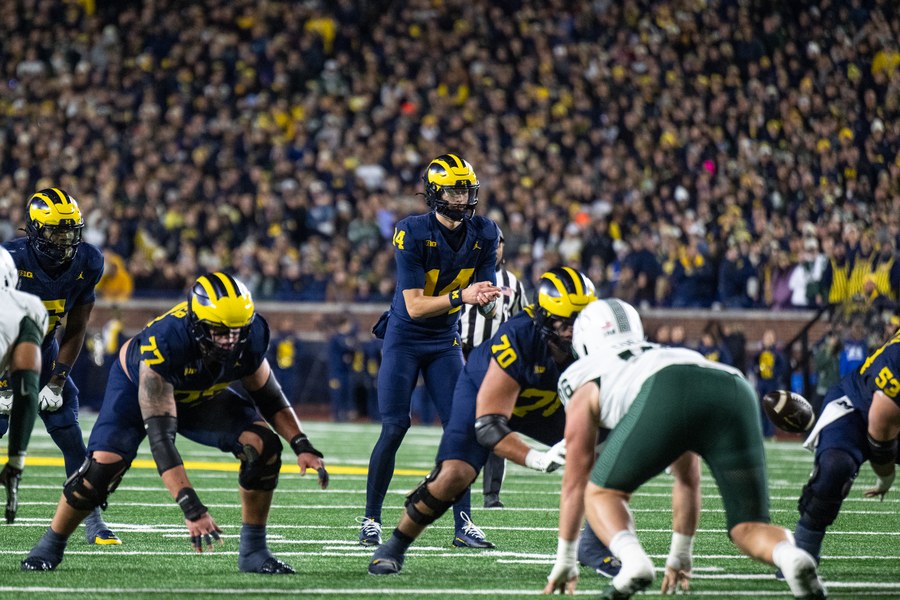
Michigan State comes to Michigan Stadium on Saturday at 7:30 p.m. Eastern on Peacock, per Michigan's schedule page. Its defense has allowed 1,230 yards on 295 carries through eight games, 4.2 a carry with sacks counted, per CollegeFootballData. That is a stingier run defense than Rutgers' by more than a yard and a half a carry.
One game of 21 first-down runs is a small sample, and the second half improved on the first. The sample that is not small is the one on the other side of the ledger: 14 conversions in 40 long third downs over seven games, then six in eight. If Michigan's first-down running against Michigan State looks like it did against Rutgers in the first half, the offense will again need long third downs to fall its way, and its own record says they usually do not.
The call here is that Michigan averages under 4.0 yards a carry on its first-down runs against Michigan State, by the official play-by-play, with kneel-downs and fumbled snaps left out. The other side is Michigan's own split: it cleared 4.0 on first-down runs in four of its eight games, including 6.7 against Penn State.
The fix, if there is one, was visible on the same afternoon. Carr completed every first-down pass he attempted in the first half. Michigan stopped asking him to after halftime.
Sources: CollegeFootballData's 2026 play-by-play files for Michigan's eight games, its 2026 drive files for Michigan and for all FBS games, and its 2026 season statistics for Rutgers and Michigan State; Michigan Athletics' football schedule page, opened November 2, 2026.