UTEP forced one Michigan punt all day, and it came in the first quarter
Michigan had 11 possessions and scored on seven. It was stopped once, fumbled twice and ran out the clock on the last one. The 52 points were not a field-position gift either. Michigan's six touchdown drives covered 59 yards on average, and only one possession all afternoon began inside UTEP's 40.
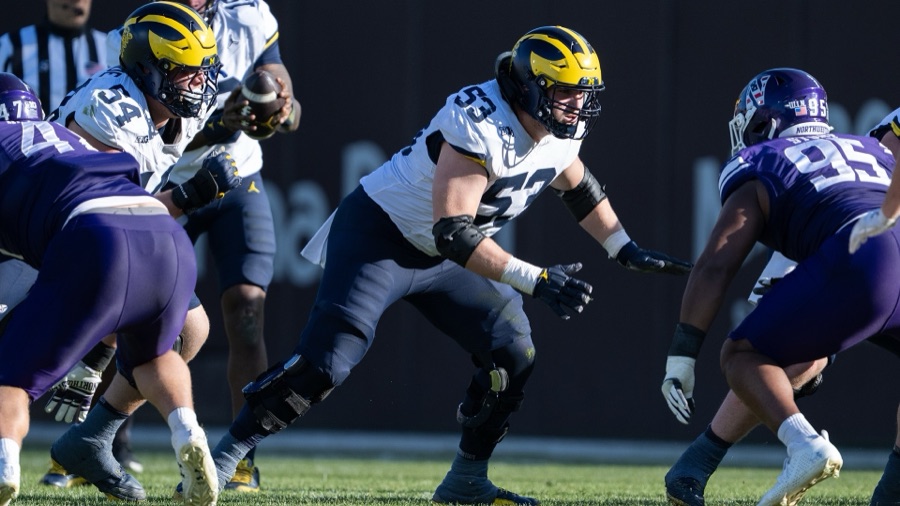
Michigan punted once on Saturday. The punt came with 4:52 left in the first quarter, on fourth-and-2 from Michigan's own 33, and Cam Brown did not walk onto the field again.
That is the complete record of what UTEP's defense did at Michigan Stadium.
Michigan had 11 possessions in a 52-17 win. Six ended in touchdowns, one in a field goal, one in that punt, two in Michigan fumbles, and the eleventh was the last 1:45 of a 35-point game. So of the ten possessions Michigan was actually trying to score on, seven produced points. The three that did not were one punt and two fumbles Michigan put on the ground itself.
The version of this game a scoreboard tells you is that Michigan trailed 14-7 in the second quarter, found something at halftime and buried a Mountain West team. The drive chart tells a different one. UTEP's defense stopped Michigan once, in the first quarter, and everything that looked like a slow start after that was Michigan handing the football over.
Nobody gave Michigan a short field#
Michigan's six touchdown drives covered 68, 75, 52, 46, 62 and 51 yards. The average is 59. The shortest of the six was 46 yards, which is more than half a field. Against a team that gained 150 yards all afternoon, none of the scoring was cheap.
Three of Michigan's 11 possessions began in UTEP territory, at the UTEP 49, the UTEP 46 and the UTEP 31. The first of those produced Trey Butkowski's 49-yard field goal at the end of the first half. The second produced a touchdown. The third was that last possession, and Michigan ran three plays and let the clock go. That is the only possession all day that started inside UTEP's 40.
Turnovers ran one direction on Saturday and they ran against Michigan. UTEP lost none and Michigan lost two, and both UTEP touchdowns came on possessions that began after a Michigan fumble. Michigan won by 35 anyway, on drives it had to go and get.
UTEP's offense did not slow down. It went backwards#
Start at 1:31 of the second quarter, the possession after Michigan had tied the game at 14-14, and run to the last play of the third quarter. UTEP had five possessions in that span.
It ran 14 plays from scrimmage on those five possessions and lost 5 yards on them, net. Four of the five were three-and-outs that ended in punts. The fifth ended when Jonah Lea'ea intercepted EJ Colson Jr. and returned it for a touchdown.
Those possessions died on first and second down, well before third.
UTEP ran five first-down plays in that span and gained 1 yard on them: 0, 0, 0, minus 2 and 3. Then it ran five second-down plays and lost 15 yards: minus 1, minus 1, 4, minus 8 and minus 9. Two of those second downs were sacks and one was a run for a loss.
So by the time UTEP arrived at third down it needed 6, 11, 11, 20 and 21 yards. It converted none of the five, and the last one was the interception.
That is the whole mechanism of the third quarter, and it has nothing to do with third-down defense. Michigan won first down, which made second down long, then won second down by more than it had won first down, which made third down unplayable. UTEP never got to make a real decision.
The same gap shows up across the whole game#
Michigan faced 13 third downs on Saturday and they averaged 4.3 yards to go. UTEP faced 12 and they averaged 10.2. Michigan converted 9 of its 13. UTEP converted 2 of its 12.
Those two averages are the game. The two offenses arrived at third down almost 6 yards apart, and almost 6 yards is the difference between a down you can play and a down you cannot.
Michigan reached third-and-2 or shorter four times and third down needing more than 7 yards once. UTEP reached third-and-10 or longer seven times in 12. An offense whose average third down is 4.3 yards is choosing from its whole playbook. An offense whose average third down is 10.2 is throwing into a defense that knows it.
UTEP also had almost nothing outside the structure. It ran 47 plays from scrimmage and two of them gained 15 yards or more. Both were touchdowns, the 45-yard throw to Cash Cheeks in the first quarter and the 18-yard throw to Lamar Sperling that made it 14-7. The other 45 plays gained 87 yards between them, which is 1.9 a play, and produced one field goal.
Michigan finished with 11 tackles for loss. It had six in the opener and eight against Oklahoma.
Michigan stopped punting on purpose, too#
Michigan faced fourth down three times all afternoon, which is what happens when you convert 9 of 13 on third down. It punted on the first one and went for the other two, and both of those were from the UTEP 40.
The first came on the last drive of the first half, fourth-and-1, and Bryce Underwood threw 9 yards to Andrew Marsh. That set up the 49-yard field goal that gave Michigan its first lead of the afternoon, 17-14. The second came in the third quarter with Michigan ahead 24-14, fourth-and-4, and Underwood threw 10 yards to Travis Johnson. That drive ended in a touchdown six plays later.
Neither of those is a desperate call. Both were Kyle Whittingham deciding that his offense at the opponent's 40 was a better bet than his punter, and both drives produced points.
What three games say, and what they do not#
Michigan's defense has now faced 33 possessions this season. It has allowed three touchdowns on them.
The denominator is exactly 11 possessions in each of the three games, which is a coincidence and a useful one. Western Michigan had 11 and scored no touchdowns, kicking four field goals in a 13-12 loss. Oklahoma had 11 and scored one. UTEP had 11 and scored two, and both of those possessions started after a Michigan fumble. Opponents have converted 13 of 43 third downs, 30.2%, and have gained 221, 289 and 150 yards.
Three games is three games, and the three are not equivalent. Western Michigan is a MAC team. UTEP is 1-2, was shut out 51-0 at Oklahoma two weeks before it came to Ann Arbor, and its best result this season is beating an FCS team by 41. Oklahoma was the one ranked opponent on the schedule so far, and Michigan held it to 10 points and one touchdown on 11 possessions. That result is the part of this record a schedule argument cannot discount.
The specific thing Saturday does not tell you is whether Michigan can win first and second down against an offense that is good at first and second down. UTEP ran 32 times for 57 yards, 1.8 a carry, and an offense that cannot run at all is an offense whose second down is already decided. Iowa, ranked 17th in this week's AP poll with Michigan 18th, has been built for two decades on exactly the down-and-distance game Michigan won on Saturday, and it is at Michigan Stadium on Saturday at 3:30 p.m. Eastern.
That is the test the drive chart sets up. Michigan spent three weeks getting opponents to third-and-long. The next opponent's entire idea is not letting that happen.
Sources: CollegeFootballData, read September 21, 2026: the 2026 Michigan schedule file for the result and the Iowa date; the week-three play file for every down, distance, yard line and drive start used above; the week-three drive file for possession counts, starting field position and results; the week-three team and player files for the official box score; the week-one and week-two drive and team files for the season-to-date possession counts, yards allowed and tackles for loss; the UTEP schedule file for the Oklahoma and Texas Southern results; and the week-four rankings file for the AP Top 25. ESPN's box score for Michigan and UTEP, September 19, 2026, for punts, punt average, total yards, sacks and fumbles lost. The University of Michigan football roster at mgoblue.com and the UTEP football roster at utepminers.com for player names and positions. Two notes on the data. CollegeFootballData's yardage field disagrees with its own play description on four rows of this game, all of them sacks or penalties; every yardage figure above was re-derived from the play descriptions and the yard-line progression, and UTEP's total reconciles to the official 150 and Michigan's to the official 431. And the five-possession span counts the 14 plays from scrimmage that were not intercepted, with the interception named separately.