Oakland Never Owned The Teams. It Owned The Ground.
On July 13 the city voted to sell its half of the Coliseum complex. The nine acres under the arena were priced at nearly as much as the hundred and three acres under the stadium, and that gap is the whole sixty-year story.
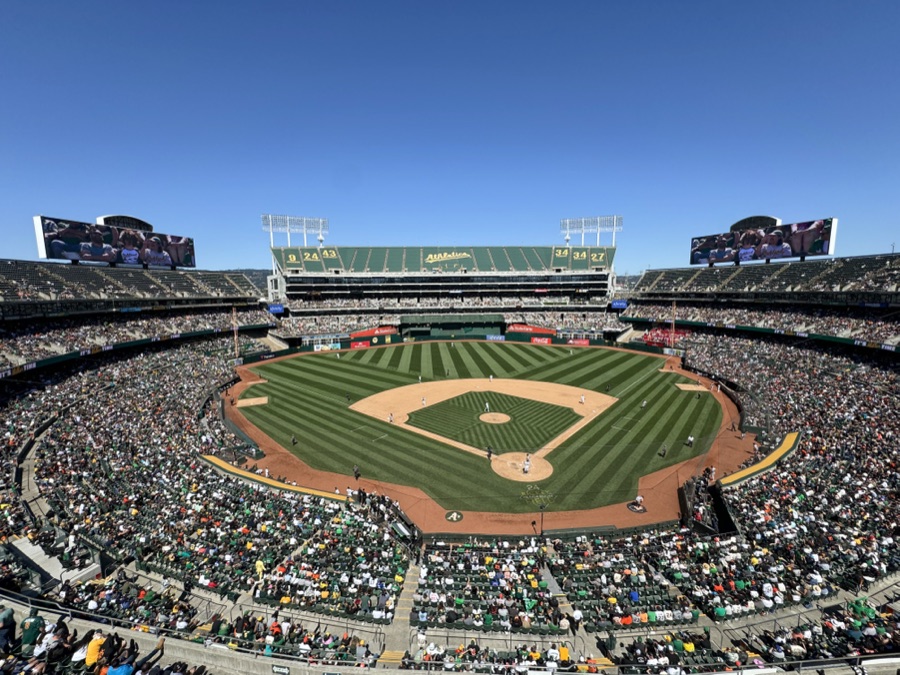
In May 1975 the Golden State Warriors won a championship, and they could not play their home games at home.
The Oakland Coliseum Arena, the building they had moved into four years earlier, was booked for the Ice Follies. So the Warriors carried Games 2 and 3 of the NBA Finals down to the Cow Palace in Daly City, in a different county, and beat the Washington Bullets there twice. Rick Barry scored 36 points in the first and 38 in the second. Then they finished the sweep in Landover, Maryland, and came home to a building where the ice was already going back down.
That is the Oakland Coliseum complex in one anecdote, fifty-one years before the city sold it. Two publicly owned rooms on a flat stretch of East Oakland between the freeway and the BART tracks, let out by the night to whoever held the date. The Warriors were tenants. The ice show was a tenant. Oakland and Alameda County were the landlord.
Being the landlord and being a sports town are two different conditions, and Oakland spent six decades behaving as though they were one.
The vote#
On Monday, July 13, the City Council voted 6 to 1 to stop being the landlord. Councilmember Noel Gallo cast the no vote.
The buyer is Oakland Acquisition Company, an entity formed by the African American Sports and Entertainment Group and Loop Capital. The terms, as reported by The Oaklandside and CBS News Bay Area: $50 million for the city's half of the nine-acre arena parcel, $60 million for its half of the 103-acre stadium parcel, $110 million in cash, and a further $15 million once the buyer pulls building permits. After that the city takes six percent of gross ticket sales from events on the site, which Oakland North reported the city estimates at roughly $3 million a year. Oakland stops paying about $6 million a year to operate a complex with no teams in it.
The county left first. In December 2019 the Alameda County Board of Supervisors voted to sell its own fifty percent to an Athletics affiliate for $85 million. In 2024 the Athletics, by then leaving for Sacramento and eventually Las Vegas, agreed to pass that half to AASEG.
So the ledger closes. Sixty years of public ownership, ended in two transactions six and a half years apart.
The argument#
Here is the claim, and a reader is free to reject it: Oakland's loss was never the three teams. It was the sixty years the city spent believing the teams were the institution, when the institution was the ground they stood on.
The public built the buildings and carried the paper. When the Raiders agreed in 1995 to come back from Los Angeles, the return was financed with public bonds, reported at close to $198 million, that paid for the luxury boxes and the upper deck that Oakland has called Mount Davis ever since. A second public borrowing followed in 1996 to renovate the arena and keep the Warriors in it. Both were sold as investments in a sports city. Both were, in plain terms, the landlord spending down the asset to hold a tenant.
Bait is what you spend to get the thing you actually want. Oakland spent the ground to keep the tenants, and when the tenants left, the ground was what remained, diminished by everything that had been borrowed against it.
Now look at what the two parcels fetched.
The city's half of the arena, nine acres, was priced at $50 million. The city's half of the stadium land, one hundred and three acres, was priced at $60 million. Nine acres came within striking distance of a hundred and three.
That is not a clean comparison and should not be presented as one. The arena is a functioning venue with a booking calendar and money coming through the doors. The stadium parcel is a development proposition that will need years, permits and capital before it earns anything at all. Land under a working building is worth more than land waiting on an entitlement, and some of that gap is simply the difference between a business and a plan.
But the direction is not ambiguous. The most valuable thing left standing on that site is a room where people gather to hear music.
What survived#
Oakland Acquisition Company intends to separate the arena from the rest of the complex and sell it on. The Oaklandside and KQED both reported that Irving Azoff's Oak View Group, which has run the same play at the Kia Forum in Inglewood and CFG Bank Arena in Baltimore, is the intended buyer.
The building has been through this before, at least in name. It opened on November 9, 1966, as the Oakland-Alameda County Coliseum Arena, was renamed The Arena in Oakland in 1997 after that renovation, sold its name to Oracle from 2006, and on September 3, 2019, having no one left to sell it to, went back to being called Oakland Arena.
The Warriors were there from the 1971-72 season through 2018-19. Forty-seven seasons. The last basketball played in the building was Game 6 of the 2019 NBA Finals on June 13, when Toronto won 114-110 and celebrated a championship on the floor. Six months later, on December 15, the Raiders lost 20-16 to Jacksonville next door and left for Nevada. On September 26, 2024, the Athletics beat Texas 3-2 in front of 46,889 people and ended fifty-seven seasons, and Oakland became a city of roughly 440,000 people with no major professional franchise at all.
All three teams are gone. The arena is the piece of the complex that still earns, and it earns by being good at the thing the Warriors were once bumped for.
The part worth being hopeful about#
AASEG says on its own website that it was founded in 2020 with the primary purpose of using sports and entertainment "to create a path for enhanced economic equity for the Black community." Mayor Barbara Lee, on the day of the vote, called it "a deal that will bring city revenues, create good paying jobs, drive real economic opportunities."
Whatever else is true of this sale, it is the first time in the complex's history that a share of the ground beneath it will be held by a group that is from the place the ground is in. For sixty years the land was owned by two public agencies and rented to franchises headquartered elsewhere in spirit and eventually in fact. That changes on this deal, and it is not a small thing.
It is also, so far, a promise. The community benefits attached to stadium land have a long record of being announced at the vote and negotiated down afterward, and $125 million is the headline while $110 million is the cash and $15 million is contingent on permits that do not yet exist. The right posture toward a deal like this is not celebration and not cynicism. It is a calendar reminder.
The ice goes back down#
In 1975 the ice show outranked a championship team, and for fifty-one years that has been told in Oakland as a small indignity, the kind of thing that happens to a city that cannot get its own arena on the phone.
It was not an indignity. It was the business, stated plainly, decades before anyone was ready to hear it. The building's job was to be full. Basketball was one way to fill it and the Ice Follies were another, and on that particular week in May the ice had the better claim.
On July 13 the City Council sold its half of nine acres of that logic for $50 million, and its half of a hundred and three acres of football and baseball for $60 million, which is the same fact with the sentiment removed.
Oakland did not sell its history this month. It sold that in installments, in 1995 and 1996 and 2019, every time it borrowed against the ground to hold a tenant that was already looking at other cities. What it sold on July 13 was the last half of the ground.
The ground was the only thing it ever actually had.