Sharks
Sharks contract desk

Pricing the Celebrini extension: the number, the deadline nobody is talking about, and what every dollar costs the core
GS
Grab Some PineJun 11, 20265 min read
Every call on this site goes on a public ledger and gets graded. The misses stay up.
Pricing the Celebrini extension: the number, the deadline nobody is talking about, and what every dollar costs the core

The offseason outline calls this "the single most important signing of the summer" and pencils in eight years at $13.5M, and we have never once stress-tested that number. So here is the full case: the platform, the comps in the only currency that matters, the bridge question, a deadline hiding in the CBA, and the cascade math that explains why every dollar of this negotiation is really three dollars. He became extension-eligible on July 1. This is happening soon, so let us know what we think before it does.

1. The platform: there is no leverage argument against him#

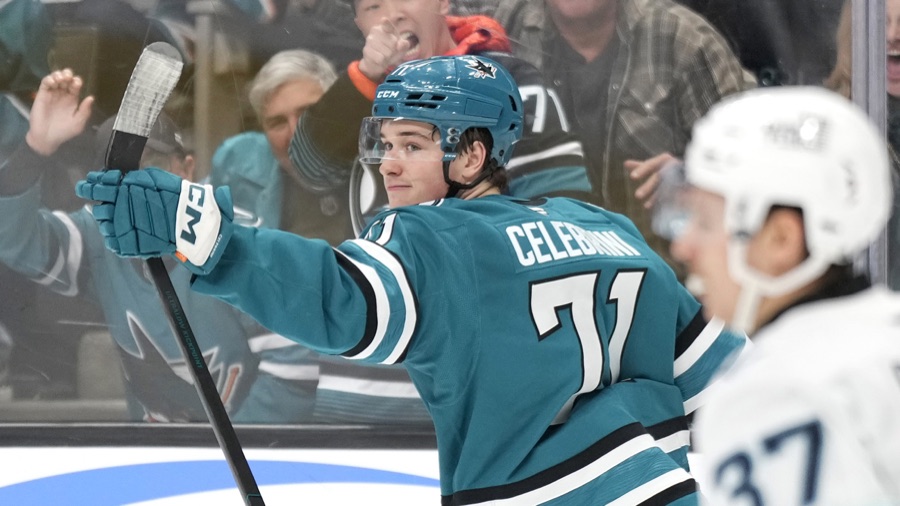
Celebrini's agent walks in with the following: 115 points at age 19, a franchise record that broke Joe Thornton's mark, fourth in NHL scoring behind three Hart-trophy-aged superstars, a top-five MVP finish, the first teenager in franchise history to crack 100, and the Cup Checklist's Franchise Forward slot filled at the exact target number (18.1 net rating). There is no "prove it" argument available. The only questions are the percentage, the term, and the timing. The good news is that all three have right answers.

2. The comps, in percentage of cap, because dollars lie on a rising cap#

Every famous second contract looks different in raw dollars and identical in cap share. That is the table that matters:

Second contractDealShare of cap at signingCelebrini-equivalent on a $113.5M cap
McDavid (the ceiling)8 x $12.5Mabout 16.7%about $19M
Matthews5 x $11.63Mabout 14.3%about $16M
Draisaitl8 x $8.5Mabout 11.3%about $13M
Jack Hughes (signed early)8 x $8Mabout 9.8%about $11M
MacKinnon (the gift)7 x $6.3Mabout 8.6%about $10M

Read the repo's two penciled numbers against that column. $13.5M is 11.9% of the projected 2027-28 cap, the Draisaitl tier. $15M is 13.2%, still below the Matthews tier. Professor Hockey's "$15M-plus imminent" is, in percentage terms, asking Celebrini to take meaningfully less than McDavid took off a comparable platform. The McDavid-share ask ($19M) is the agent's opening anchor and nobody expects it to land there, but it frames the honest range: fair market is $15M-to-$16M, and anything at $14M or under is a hometown win the franchise should sprint to the printer for. One more thing the Sharks' side gets to say, and it is true: on a cap headed toward $125M-plus by the back half of the deal, a $13.5M hit that starts at 11.9% finishes around 10%. A flat number on a rising cap is a built-in annual discount. That is the pitch.

3. The bridge question, asked and executed#

The bridge case (two or three years at $8M-to-$9M, keep powder dry for the 2027-28 crunch) dies on contact with arithmetic. A bridge on a franchise center is a bet that he gets worse. If he repeats 115, or grows, you re-price him in 2029 at his absolute peak, off an even bigger platform, on a $125M cap, as a player two years from unrestricted free agency. Tampa bridging Point worked because Point was a second-rounder with something to prove; Celebrini is a first-overall pick who already proved it at 19. The bridge saves roughly $5M a year for two years and then costs $3M-to-$4M a year for the six after, plus it moves his UFA date toward the heart of the window. Max term is the whole game here: eight years signed at 19 buys his age-21-through-28 seasons, every single one of them prime, and delays unrestricted free agency to 2035. No team in hockey has ever regretted maxing the term on a generational center's second contract. Several have regretted not doing it.

4. The deadline nobody is talking about: September#

The read

The new CBA that takes effect this September trims the maximum contract length from eight years to seven for a team re-signing its own player. Which means the eighth year of a Celebrini extension exists only in the window between July 1 and the new agreement kicking in. Sign in that window and you can buy eight years. Wait until midseason and the best you can do is seven, with his price rising every game he plays. The eighth year, at any sane AAV, is the cheapest year of prime Celebrini anyone will ever purchase. The deadline does the negotiating urgency for you, on both sides, which is probably why the reporting says this gets done on or near July 1. It should.

5. The cascade: every Celebrini dollar is three dollars#

Here is why the difference between $13.5M and $15M is bigger than $1.5M. Celebrini's number becomes the ceiling of the internal pay scale, the reference point every agent behind him negotiates against. Smith's extension (penciled at $7.5M) prices off it. Misa's and Dickinson's deals in 2028 price off Smith's. Chernyshov and Askarov follow. The young-core total is already projected to land anywhere from $50M to $70M-plus, and that entire band stretches or compresses around the top number. The direct arithmetic: $1.5M a year for eight years is $12M of cap space, roughly a full Desharnais contract every season of the deal, or, in 2028-29 terms, the difference between absorbing a deadline rental's full freight and asking the kids to win round one alone. And the indirect arithmetic is bigger: a Celebrini who signs at 11.9% gives every teammate's agent a discount precedent, the MacKinnon effect, which is the actual mechanism by which Colorado kept a contender together. A Celebrini who extracts 14% resets everyone's ask upward. The first domino decides the angle of all of them.

The verdict#

The read

The number here: eight years, and sign anything from $13.5M to $15M, before the September CBA window closes. The term and the timing matter more than the last million.

Open at $13.5M (the Draisaitl share, defensible off the rising-cap pitch), expect to land near $14M-to-$14.5M, and do not blink at $15M, because 13.2% of cap for the fourth-best scorer in hockey entering his age-20 season is still below the Matthews line. The only actual mistakes available are the bridge (re-pricing a rising asset at his peak), shaving the term (donating prime years to 2034 free agency), or dithering past September (losing the eighth year to the CBA). The repo already said this is the most important signing of the summer. The honest addendum is that it is also the easiest: the player is not the negotiation. The calendar is.

Platform stats per docs/Sharks_2025-26_Season_Summary.md (115 points, franchise record, 4th in NHL scoring) and the Cup Checklist (18.1 Franchise Forward, filled). Cap projections ($104M to $113.5M to $125M-plus) and the $13.5M pencil per docs/offseason-outline.md; the $15M-plus read per Professor Hockey (May 31 clipping). Comparable second contracts cited at their cap share at signing (approximate). The CBA max-term change (eight years to seven for own-team re-signings, effective September 2026) per the new collective agreement's published terms. Eligibility: extension-signable as of July 1, 2026; an extension does not touch the 2026-27 cap (final ELC year, $975K, per state/cap.md).
Filed under Sharks

More in The Cap Sheet

The whole thread →
Sharks Player Note

Re-judging the Eklund trade: the data says they sold a rising player at the bottom of his luck

How good was Eklund, really, and what that does to the trade grade

Grab Some PineJun 25, 20265 min read
Re-judging the Eklund trade: the data says they sold a rising player at the bottom of his luck
Free Agency Target Board

Top 5 free-agent D to target: Andersson is the prize, and the right-shot well is shallow behind him

Five free-agent D to chase, and the honest truth about how thin it is

Grab Some PineJun 25, 20266 min read
FREE AGENCY TARGET BOARDAndersson or Carlson,not bothgrabsomepine.comsharks
Sharks Cap Note

The salary floor after Eklund: $21M the Sharks are required to spend, not free to spend

The floor, not the ceiling, is the Sharks' real number

Grab Some PineJun 24, 20267 min read
The salary floor after Eklund: $21M the Sharks are required to spend, not free to spend

More on Macklin Celebrini

His page →
Season preview

Celebrini scored 45 goals on 31.8 expected, and San Jose is betting on the gap

Macklin Celebrini scored 45 goals on 31.8 expected goals last season, a gap of 13.2 that ranked fourth among the 411 NHL forwards who played 40 games or more. With him on the ice at five-on-five the Sharks were level on expected goals; without him they were at 46 percent. He plays this season on the last year of a $975,000 entry-level deal before an $18,800,000 cap hit begins. Training camp opens today.

Dom CahillSep 17, 20267 min read
Celebrini scored 45 goals on 31.8 expected, and San Jose is betting on the gap
Season preview

Collin Graf Scored More Shorthanded Than He Did On The Power Play

Collin Graf spent 39 minutes and 38 seconds on the power play across 81 games last season, tenth among San Jose forwards, and 200 minutes killing penalties, which was first. He scored 21 goals anyway and finished with 42 even-strength points, tied with Will Smith for second on the team behind Macklin Celebrini. San Jose then signed him for three years and $12,750,000. The open house row on him says he reaches 50 points, and the entire case for that is usage the club has never given him.

Dom CahillSep 8, 20265 min read
Collin Graf Scored More Shorthanded Than He Did On The Power Play
Season preview

Of Alexander Wennberg's Twenty And A Half Minutes A Night, Five And A Half Came On Special Teams

Alexander Wennberg scored 55 points in 80 games last season and averaged 20:27 a night. Three minutes twenty of that was power play, second on the whole roster behind Macklin Celebrini, and two minutes eight was penalty kill. The demotion every projection has him taking is an even-strength demotion, and both published power-play projections keep him on the first unit. The number that threatens the 55 is a 19.4 percent shooting rate against a career mark of 11.4 across 869 games.

Dom CahillSep 4, 20265 min read
Of Alexander Wennberg's Twenty And A Half Minutes A Night, Five And A Half Came On Special Teams

On the record

Called Shots →
OpenJul 29, 2026

Macklin Celebrini's $18.8 million average annual value is NOT the highest in the NHL on July 29, 2027. Scored off any active standard player contract carrying a higher AAV on that date, signed by any player on any club, and counting a signed extension that has not yet taken effect. A hit means at least one such contract exists; a miss means $18.8 million still stands alone at the top.

This follows from the piece's own argument rather than from a hunch about a particular player. The upper limit went from $95.5 million to $104 million to $113.5 million in three seasons, which moves the 20 percent individual ceiling from $19.1 million to $20.8 million to $22.7 million. Records set against a rising cap do not age. The two most recent ones prove it: Kirill Kaprizov's $17 million did not survive a full season, and Leo Carlsson's $18 million lasted about three weeks before Celebrini passed it. Against the call, five-year deals at the ceiling are still rare, most extensions of this size are signed in July and August rather than mid-season, and the specific players who could clear $18.8 million next summer are not yet identifiable, so this is a structural bet and not a roster read. It loses cleanly if the league's next tier of contracts continues to land at 16 to 17 percent of the cap in AAV rather than chasing the raw dollar record. Added 2026-07-29, same night, from Leo's audit: the $22.7 million forward ceiling assumes the CBA's 20 percent individual maximum survives the changeover in September. This call resolves on July 29, 2027, which is after that, so a rule change is a live risk to the mechanism the call leans on. It does not invalidate the call, since a higher ceiling and no ceiling both make it easier and only a LOWER cap on individual salary would protect the record. Recorded because a take should carry the assumption it rests on rather than have it discovered at scoring.

Latest on the Sharks

The whole beat →
Preseason

San Jose lost 6-2, and both of its goals came from men with no NHL games

San Jose's scorers had no NHL games behind them. The lineup gap, five-on-five volume and shot distances put the 6-2 loss at Anaheim in proportion.

Dom CahillSep 21, 20264 min read
San Jose lost 6-2, and both of its goals came from men with no NHL games
Preseason Preview

Only two clubs in hockey ran two power-play point men, and San Jose was one

San Jose plays its first exhibition game at Anaheim on Sunday at 1 p.m. Pacific, the first of four inside seven days before the October 1 opener against Florida. Measured against the NHL's own time-on-ice database for all 32 clubs in 2025-26, 17 clubs gave more power-play time to a left-shot defenseman than to any right shot, and 11 gave no right-shot defenseman even 100 minutes. Those 11 averaged a 22.00 percent power play against a 21.10 percent league mean. San Jose and Florida were the only clubs to give two defensemen 150 minutes or more. The Sharks blue line brings 307:51 of NHL power-play time to camp and 202:55 of it belongs to Orlov.

Dom CahillSep 20, 20265 min read
Only two clubs in hockey ran two power-play point men, and San Jose was one
The contract market

Will Smith's old linemate got eight years on the last day they existed

The collective bargaining agreement that took effect on September 16 cuts the maximum contract term from eight years to seven with a player's own club, and from seven to six with anybody else. Washington signed Ryan Leonard, Will Smith's linemate from the national development program and from Boston College, to eight years and $84 million on the final night the term was legal, and signed Justin Sourdif to eight the same day. Ottawa gave Drake Batherson eight and $86 million. Smith is going into the last season of a three-year entry-level deal at $950,000 and is unsigned. His unrestricted free agency arrives in 2031, so an eight-year extension beginning in 2027-28 would have bought four summers past it and a seven-year extension buys three. The year San Jose lost on Tuesday is the one in which Smith turns 30. Mike Grier said on Thursday that talks are in a good spot and that there are no plans to talk next week. One take filed, on when Smith signs.

Grant LombardSep 19, 20265 min read
Will Smith's old linemate got eight years on the last day they existed

Earlier on the Sharks

The empty room

The Sharks cost eight cents to trade. The 49ers cost one.

Backing the Sharks to make the playoffs costs 12.5 percent of the position in transaction cost before the puck drops. The same position on the 49ers costs 1.5. The driver is open interest: the NHL playoff board holds 10,304 contracts against the NFL board's 1,080,143, and across 163 contracts on five boards the rank correlation between open interest and spread is minus 0.660. The NFL board carried a sixteen-cent spread of its own in February on 2,830 contracts, and reached one cent by May.

Casey MontgomerySep 18, 20269 min read
The Sharks cost eight cents to trade. The 49ers cost one.
Prospect Pool Ranking

Sharks top 20 Calder-eligible prospects: Pohlkamp belongs near the top, and two dark horses lurk

The top 20 Calder-eligible Sharks prospects

Grab Some PineJun 27, 20264 min read
PROSPECT POOL RANKINGThe top 20 Calder-eligibleSharks prospectsgrabsomepine.comsharks
Sharks prospect desk

Pohlkamp: the bridge to the bridge, and the only Sharks prospect whose shot is already NHL-ready

Eric Pohlkamp and the right side's missing middle chapter

Grab Some PineJun 11, 20265 min read
SHARKS PROSPECT DESKPohlkamp is thatassumption, wearing a namegrabsomepine.comsharks