Sharks
Season preview

Sam Dickinson Was Better Against The Best Forwards He Faced Than Against The Worst Ones

The Sharks 25, No. 5. San Jose kept its teenage defenseman away from the other team's top line all of last season and fed him depth minutes instead. He won the minutes he was protected from and lost the ones he was handed. That is the argument for taking the protection off, and a club chasing a playoff spot after seven misses has an obvious reason not to.
DC
Dom CahillSep 13, 20265 min read
Every call on this site goes on a public ledger and gets graded. The misses stay up.
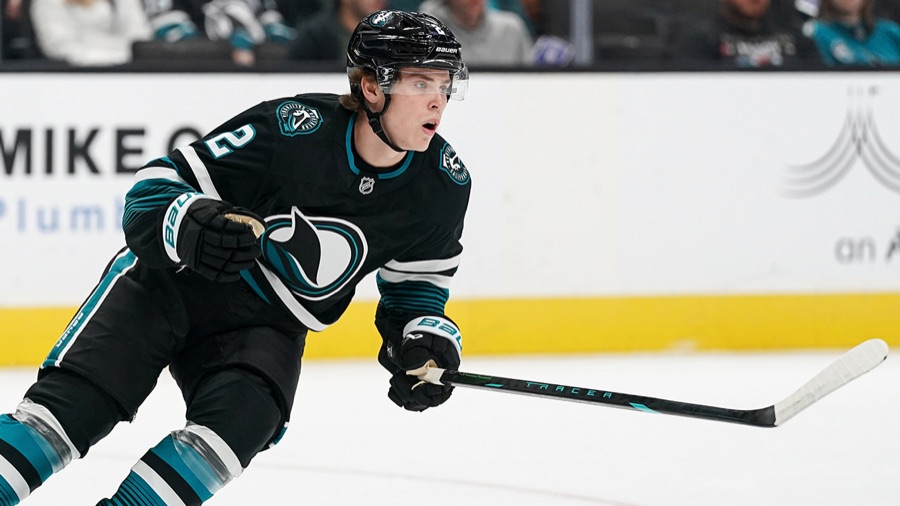
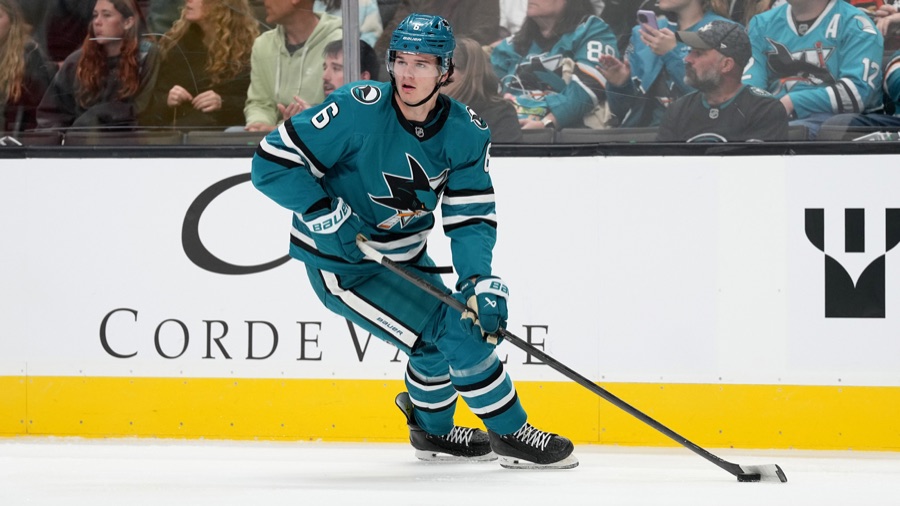
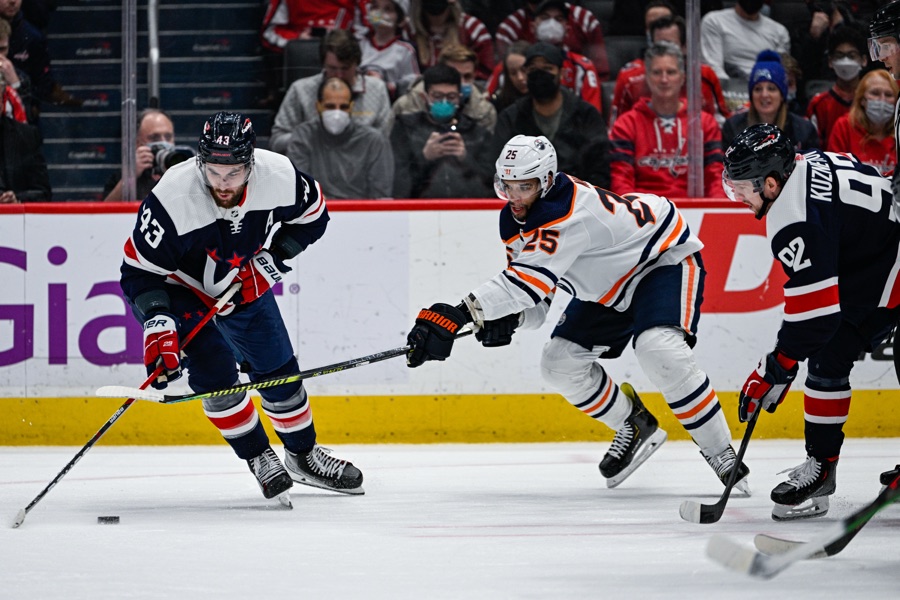
Sam Dickinson carrying the puck up out of his own zone at SAP Center, in San Jose’s teal home sweater with the Sharks fin crest and the number 6 on his shoulder, teal helmet and white pants. A teal home crowd is out of focus behind the boards.

Take the even-strength minutes Sam Dickinson played last season and split them by the quality of the forwards on the other side of the puck. PuckIQ's WoodMoney model does that for you, in three tiers of opponent. Now read his season from the hardest tier down.

Against elite competition he played 220.7 minutes, 23.2 percent of his even-strength time. San Jose outscored the opposition 15 to 11 with him on the ice, and his share of danger-adjusted unblocked shot attempts ran 5.2 points better than his own teammates managed against the same tier.

Against the softest tier he played 385.1 minutes, 40.4 percent of his time. San Jose was outscored 19 to 12, and that same figure against his teammates ran 9.0 points worse.

Both samples are small. What they do is point the same way on two instruments, goals and shot quality, and that way is the opposite of what a protected rookie is supposed to produce. He was hardest to score on in the minutes the staff was working hardest to keep him out of.

Where the shelter actually was#

Ryan Warsofsky pointed Mario Ferraro at elite forwards for 39.0 percent of his even-strength time last season and Dmitry Orlov for 35.3. Dickinson got 23.2. Same roster, same coach, same year, and roughly sixteen points of separation between the rookie and the man given the shutdown job.

He was not protected anywhere else. Hockey Reference has his offensive zone start share at 46.7 percent, the lowest of the six defensemen San Jose has under contract this season. He averaged 16:45 a night across 72 games, third in total minutes on the blue line, and killed penalties at 0:54 a game.

What he did not get was the power play. He averaged 0:18 a game, about 22 minutes all season. John Klingberg and Orlov had that job, at 2:57 and 2:28 a night, and Klingberg announced his retirement on September 11.

Why the cheapest defenseman is the important one#

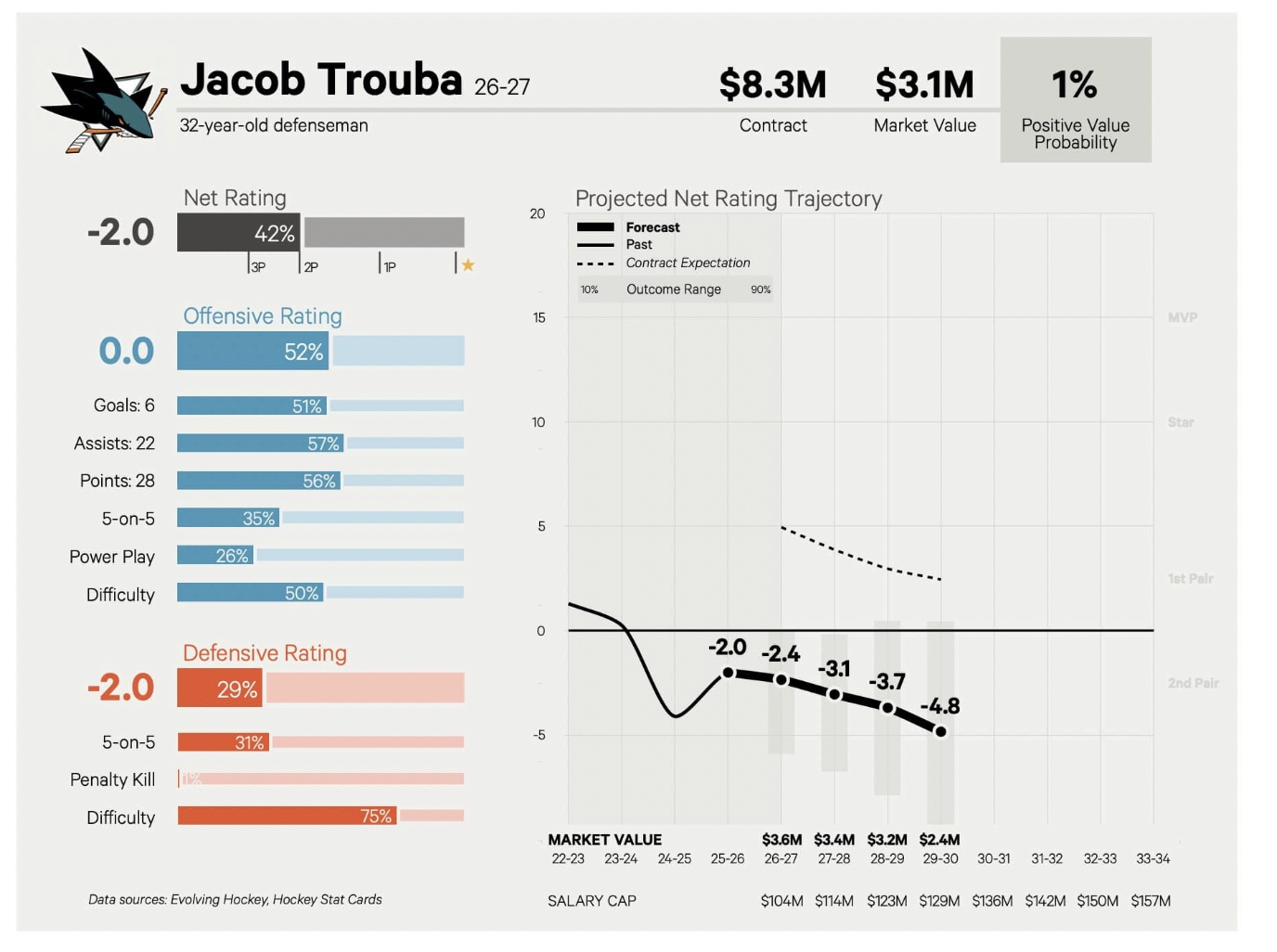
San Jose bought this blue line. Darnell Nurse at $9,250,000 and Jacob Trouba at $8,250,000 are signed through 2029-30. Dickinson is the piece the club drafted, at a cap hit of $953,750 this season and next, per PuckPedia.

That arithmetic works one way. If the 20-year-old handles the hardest even-strength minutes, the $17,500,000 of Nurse and Trouba becomes depth. If he does not, that money is the top pair for four more years, and San Jose is paying market rate for what its own draft was supposed to produce.

Best case for San Jose#

The elite share climbs from 23.2 percent toward the 35-to-39 band Ferraro and Orlov lived in, and the relative results hold when it does. That is worth more to this club than points are. Warsofsky stops having to hand the other team's first line to two veterans in their thirties, and the next two blue lines get built around a defenseman already under contract.

The offense would follow a deployment decision rather than a development one. He attempted 199 shots last season and got 72 to the net, 36.2 percent. Klingberg is gone and Orlov is in the last year of his deal, so a point on one of the two power-play units is open for the first time since Dickinson arrived.

Three arguments against that, and the first one is real#

One. Twenty-three percent elite exposure was a decision, not an accident, and the people who made it watched every shift. Professor Hockey's September 1 read is that the squeeze tightens rather than loosens, because the club is now chasing a playoff spot and "those risks become more risky," and that Dickinson ends up "a 20 to 25 point defensive defenseman."

Two. The soft-minutes sag is not nothing. Minus 9.0 came in the 40.4 percent of his season that was his largest tier, and the simplest reading is a 19-year-old who locked in for marquee shifts and drifted through the grind ones. That is a consistency problem, and consistency does not get fixed by harder assignments.

Three. He committed 83 giveaways against 20 takeaways in 1,206 minutes. Elite forwards punish that more than depth forwards do, which is a reason the 220 minutes could be the noisy number rather than the true one.

Worst case for San Jose#

Not that Dickinson is bad. That the club, seven seasons out of the playoffs and finally trying to end it, protects itself for a second straight year. The elite share stays near 23 percent, the power-play column stays near zero, and San Jose reaches next summer still not knowing whether its own first-round defenseman can carry a top pair, while the two men carrying it are signed through 2029-30.

That is where his interests and the club's come apart. A comfortable role and clean counting numbers are fine for him. For San Jose, a season that answers nothing is a season spent paying $17,500,000 to avoid the question.

What to watch in October#

The power-play column, and it takes one box score. Dickinson has never averaged more than 0:18 a game there. If he is on a unit in the opener against Florida on October 1, the muzzle is off and this staff has changed its mind about what he is for.

Then the zone-start split, which takes longer and says more. Dickinson's 46.7 percent was the lowest on the roster last season and Nurse's at Edmonton was 52.3. Watch which of the two starts more shifts in his own end this year. Watch the raw possession share too, and use the raw one, because a figure measured against your own teammates does not travel between teams. Dickinson and Nurse both finished last season at 47.8 percent of shot attempts, Dickinson for an 86-point San Jose and Nurse for a 93-point Edmonton. Fifty is even. Neither got there.

The stakes#

Zeev Buium went 12th overall in 2024, one pick after Dickinson, and signed an eight-year extension with Vancouver on September 4 worth $75,040,000, an average of $9,380,000 beginning in 2027-28. Dickinson cannot sign anything until July 1, 2027 and is a restricted free agent in 2028.

The window for eight-year contracts closes Tuesday. Under the agreement that starts Wednesday, the longest deal a club can give its own player is seven years. San Jose will negotiate Dickinson's second contract on that shorter ceiling and on whatever this season puts in the file. Another year at 23.2 percent and the file will not say whether it is buying a top-pair defenseman or a good third one.

Previously in this series: No. 6, Ivar Stenberg.

Sources: PuckIQ WoodMoney, 2025-26 San Jose skaters, elite and gritensity tiers, read 2026-09-13, for the competition splits, tier ice time, tier goals and the relative danger-Fenwick figures. Hockey Reference's 2025-26 San Jose and Edmonton team pages, advanced-stats and time-on-ice tables, read the same day, for zone starts, shot attempts, shot-through rate, takeaways, giveaways, Corsi share and the even-strength, power-play and shorthanded splits. PuckPedia for cap hits and contract years, and for the Buium contract. San Jose Hockey Now, September 12, 2026, for John Klingberg's retirement, which he announced on September 11. Professor Hockey, September 1, 2026, for the storyline on Dickinson's role. The club's 2026-27 schedule for the October 1 opener.
Filed under Sharks

More on Darnell Nurse

His page →
Season preview

Edmonton Spent Six Seasons Taking Ice Time Away From Darnell Nurse

Edmonton cut Darnell Nurse's power-play time by 75 percent in his final season there, from 77 minutes and 53 seconds to 19 minutes and 24 seconds, and his total ice time fell to 20:58, the lowest of his last nine seasons. Sam Dickinson, a 19-year-old rookie, took more power-play time per game for San Jose than Nurse took for Edmonton. San Jose owns the contract until 2030 and cannot move it this season.

Dom CahillSep 10, 20265 min read
Edmonton Spent Six Seasons Taking Ice Time Away From Darnell Nurse
Deployment

Sort San Jose's Blue Line By Zone Starts And Sam Dickinson Is At The Bottom

Six defensemen are signed for 2026-27. Ranked by last season's even-strength offensive zone start rate, the least sheltered of them is Sam Dickinson, who was 19 and playing his first NHL season. The four men who actually absorbed San Jose's defensive-zone faceoffs are all off the roster.

Dom CahillAug 9, 20266 min read
Sort San Jose's Blue Line By Zone Starts And Sam Dickinson Is At The Bottom
The offseason

Mike Grier Bought The House

A blue-line overhaul was mandatory. Paying the top of the market on double the term was not. Comparable defensemen went for $4M that week and the best one available went for two years, while San Jose committed four.

Grab Some PineJul 24, 20268 min read
Mike Grier Bought The House

More on Dmitry Orlov

His page →
Preseason Preview

Only two clubs in hockey ran two power-play point men, and San Jose was one

San Jose plays its first exhibition game at Anaheim on Sunday at 1 p.m. Pacific, the first of four inside seven days before the October 1 opener against Florida. Measured against the NHL's own time-on-ice database for all 32 clubs in 2025-26, 17 clubs gave more power-play time to a left-shot defenseman than to any right shot, and 11 gave no right-shot defenseman even 100 minutes. Those 11 averaged a 22.00 percent power play against a 21.10 percent league mean. San Jose and Florida were the only clubs to give two defensemen 150 minutes or more. The Sharks blue line brings 307:51 of NHL power-play time to camp and 202:55 of it belongs to Orlov.

Dom CahillSep 20, 20265 min read
Only two clubs in hockey ran two power-play point men, and San Jose was one
Season preview

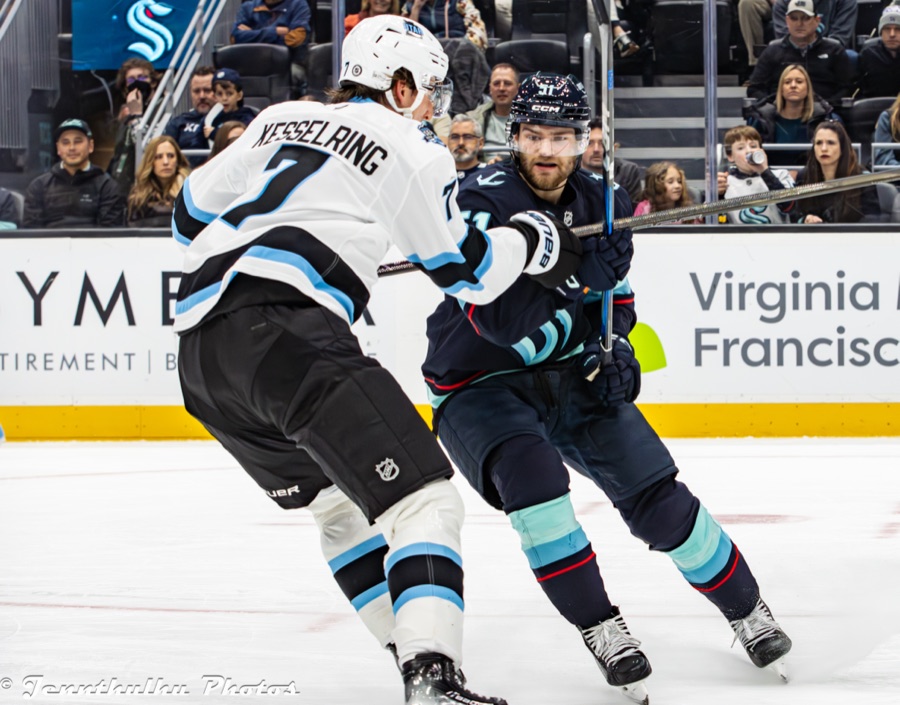
Michael Kesselring Went From Seventy Power Play Minutes To Two Seconds In One Season

Michael Kesselring played 69:49 on the power play for Utah in 2024-25 across all 82 games, then two seconds in 34 injury-shortened games for Buffalo. San Jose's blue line gave 82 percent of its power-play minutes to two men last season, Dmitry Orlov and John Klingberg, and Klingberg, a right shot, is gone. The club's roster feed lists four right-shot defensemen and two of them have never played an NHL game. Jacob Trouba, the other one who has, owns one power-play point across his last 158 games. That leaves the Utah season as the only evidence San Jose has that anybody on its right side can do the job.

Dom CahillSep 7, 20265 min read
Michael Kesselring Went From Seventy Power Play Minutes To Two Seconds In One Season
Season preview

Almost Half Of Dmitry Orlov's Points Came On A Power Play He Is Projected To Lose

Dmitry Orlov scored 37 points in 82 games last season, a career high in his fifteenth NHL year, and 18 of them came on the power play against a previous career best of eight. At even strength he had 19, the fewest of any full season he has played apart from his rookie year. He is 35, he is in the final season of a two-year deal at $6,500,000, and both published opening-night power-play projections put Luca Cagnoni at the point and leave Orlov off both units.

Dom CahillSep 2, 20266 min read
Almost Half Of Dmitry Orlov's Points Came On A Power Play He Is Projected To Lose

On the record

Called Shots →
OpenJul 2, 2026

Doing both the Trouba signing and the Nurse trade is an overcommitment whose bill lands around 2029, right as the title window opens.

Either move alone was defensible; the blue line genuinely had to be fixed. Wrong if the Sharks extend the core in 2029 and can still add without subtracting. Right if that summer is spent moving Trouba or Nurse to make room. Revisit every offseason through 2029-30.

Latest on the Sharks

The whole beat →
Preseason

San Jose lost 6-2, and both of its goals came from men with no NHL games

San Jose's scorers had no NHL games behind them. The lineup gap, five-on-five volume and shot distances put the 6-2 loss at Anaheim in proportion.

Dom CahillSep 21, 20264 min read
San Jose lost 6-2, and both of its goals came from men with no NHL games
The contract market

Will Smith's old linemate got eight years on the last day they existed

The collective bargaining agreement that took effect on September 16 cuts the maximum contract term from eight years to seven with a player's own club, and from seven to six with anybody else. Washington signed Ryan Leonard, Will Smith's linemate from the national development program and from Boston College, to eight years and $84 million on the final night the term was legal, and signed Justin Sourdif to eight the same day. Ottawa gave Drake Batherson eight and $86 million. Smith is going into the last season of a three-year entry-level deal at $950,000 and is unsigned. His unrestricted free agency arrives in 2031, so an eight-year extension beginning in 2027-28 would have bought four summers past it and a seven-year extension buys three. The year San Jose lost on Tuesday is the one in which Smith turns 30. Mike Grier said on Thursday that talks are in a good spot and that there are no plans to talk next week. One take filed, on when Smith signs.

Grant LombardSep 19, 20265 min read
Will Smith's old linemate got eight years on the last day they existed
Prospects

San Jose went 2-0 in the rookie tournament, and then Grier read the injury list

The first weekly Sharks prospect board covers September 11 through September 17. San Jose won both Rookie Faceoff games, 8-1 over Los Angeles and 3-1 over Utah, and Mike Grier disclosed on September 17 that Quentin Musty is out a couple of months at least and Cameron Lund at least a month and through the start of the regular season. Carson Wetsch is the prospect of the week on two goals, two assists and three fights across the two games. Ethan Cardwell is off the board on a verified split of 6 NHL games in 2024-25 and 7 in 2025-26, which is the disqualifying condition. For 13 of the 30 players, no primary establishes a 2026-27 club.

Dom CahillSep 18, 20263 min read
San Jose went 2-0 in the rookie tournament, and then Grier read the injury list

Earlier on the Sharks

Season preview

Celebrini scored 45 goals on 31.8 expected, and San Jose is betting on the gap

Macklin Celebrini scored 45 goals on 31.8 expected goals last season, a gap of 13.2 that ranked fourth among the 411 NHL forwards who played 40 games or more. With him on the ice at five-on-five the Sharks were level on expected goals; without him they were at 46 percent. He plays this season on the last year of a $975,000 entry-level deal before an $18,800,000 cap hit begins. Training camp opens today.

Dom CahillSep 17, 20267 min read
Celebrini scored 45 goals on 31.8 expected, and San Jose is betting on the gap
Sharks prospect desk

Five Sharks Prospects Are Enrolled In College, Which Costs Them The Rookie Faceoff San Jose Is Hosting

San Jose hosts the Rookie Faceoff from September 12 to 15 at Tech CU Arena and Sharks Ice, playing Los Angeles on the 12th and Utah on the 13th, and five of its draft picks are barred from it because they are enrolled college players: Keaton Verhoeff at North Dakota, Ryan Lin at Denver, Haoxi Wang at Boston University, Joshua Ravensbergen at Michigan State and Cole McKinney at Michigan. College Hockey Inc's eligibility rules allow a student-athlete to attend an NHL development camp and forbid him from playing in a rookie tournament. Four of the five came out of major junior and are in college only because the NCAA changed the rule in 2024. One take filed.

Dom CahillSep 6, 20266 min read
Five Sharks Prospects Are Enrolled In College, Which Costs Them The Rookie Faceoff San Jose Is Hosting
Deployment

The Open Job On San Jose's Power Play Is Not The One Luca Cagnoni Is Being Given

Sheng Peng's opening-night power-play projection, with Jack Han and Jason Demers, puts Luca Cagnoni at the point on the first unit and leaves Dmitry Orlov off both. Orlov played 203.5 power-play minutes last season and was on the ice for 32 of San Jose's 54 power-play goals. Cagnoni has played 25.9 power-play minutes in his NHL career, across nine games in two seasons, and both times San Jose called him up it put him on the power play immediately.

Dom CahillAug 19, 20266 min read
The Open Job On San Jose's Power Play Is Not The One Luca Cagnoni Is Being Given