Sharks
Deployment

The Open Job On San Jose's Power Play Is Not The One Luca Cagnoni Is Being Given

Two of the eight San Jose skaters who played the most power play per game last season are gone. One is John Klingberg, the right-shot point man, and his ice is genuinely vacant. The published opening-night projection fills it by taking Dmitry Orlov off the power play instead, and Orlov played 203.5 minutes on it and was on the ice for 32 of the club's 54 power-play goals.
DC
Dom CahillAug 19, 20266 min read
Every call on this site goes on a public ledger and gets graded. The misses stay up.
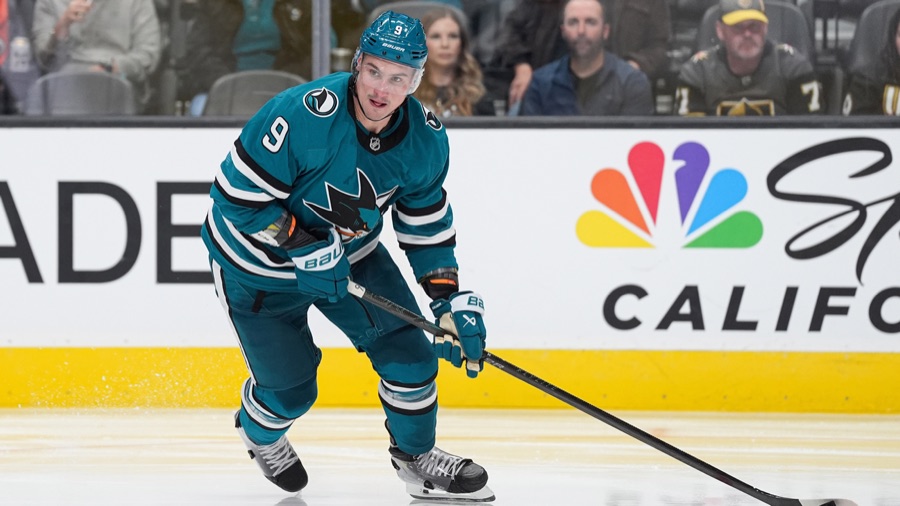
Dmitry Orlov in the Sharks' teal home sweater, number 9, carrying the puck up the ice and looking to his right, with the boards and a crowd behind him

Take every skater San Jose dressed last season, with no minimum on games played, and pull out the eight who logged the most power-play time per game. Sort them highest first. Then cross out the two who are not in the building any more.

Macklin Celebrini at 3:39 a night. Alexander Wennberg at 3:20. Will Smith at 3:18. John Klingberg at 2:57, and Klingberg is not on San Jose's cap sheet any more. Tyler Toffoli at 2:56. William Eklund at 2:54, and Eklund was traded to Ottawa in June. Luca Cagnoni at 2:47. Dmitry Orlov at 2:28.

Two names come off a list of eight, which is the whole reason there is anything to argue about. The seventh name played three games.

The projection#

On August 7, Sheng Peng published his opening-night power-play units at San Jose Hockey Now, with commentary from Jack Han and the former NHL defenseman Jason Demers. The first unit is Cagnoni at the point, Smith on the left flank, Celebrini on the right, Toffoli in the high slot and Wennberg at the net front. The second is Michael Kesselring quarterbacking behind Ivar Stenberg, Mason Marchment, Kiefer Sherwood and Michael Misa.

Ten names. Orlov is not one of them.

That is the piece. Everything else here is an attempt to work out whether it should be.

Projected unitPlayer2025-26 NHL power-play minutesGames
PP1Macklin Celebrini300.682
PP1Alexander Wennberg268.480
PP1Tyler Toffoli232.979
PP1Will Smith227.969
PP1Luca Cagnoni8.43
PP2Mason Marchment156.268
PP2Kiefer Sherwood128.572
PP2Michael Misa52.545
PP2Michael Kesselring0.234
PP2Ivar Stenbergnone, played in Sweden0
NeitherDmitry Orlov203.582

Four of the five projected first-unit forwards are exactly the four returning forwards who played the most power play last season. The forward half of this is not a projection at all, it is a continuation. The only chair that changes hands is the one at the point, and the man being moved out of it is not the man who left.

Whose ice is actually open#

Klingberg's is. He played 165.5 power-play minutes across 56 games, he was on the ice for 16 of San Jose's 54 power-play goals, and he is a right shot, which is what makes his absence a specifically shaped hole rather than a general one. San Jose still has two right shots on the blue line, Jacob Trouba and Kesselring, and between them they played 55.4 power-play minutes last season against Klingberg's 165.5. Cagnoni is not one of them. He shoots left. So does Orlov. The projection takes the one left-shot defenseman who ran this power play and replaces him with a different left-shot defenseman, and the right-shot chair Klingberg actually vacated goes to Trouba, to Kesselring, or to nobody.

Orlov's ice is not open. He played 203.5 power-play minutes across all 82 games, the most of any San Jose defenseman, and he was on the ice for 32 of those 54 goals. San Jose scored 9.4 power-play goals per sixty minutes with Orlov out there and 5.8 with Klingberg out there, which is the gap between a unit that works and a unit that is waiting for the horn.

So the club has one hole and one incumbent, and the projection fills the hole by removing the incumbent.

San Jose's six projected defensemen bring 308.7 power-play minutes to camp, and 203.5 of them belong to one man

Total NHL power-play time on ice in the 2025-26 regular season, in minutes, for the six defensemen on San Jose's projected 2026-27 blue line, per PuckPedia's cap sheet. All six played an NHL game last season, and the club where they played it is named beside each. The figure under each total is how many of that club's power-play goals the player was on the ice for. Bars run from zero to 210 minutes. Teal marks Dmitry Orlov, who is on neither projected unit, and Luca Cagnoni, who is projected to quarterback the first.

Dmitry Orlov82 games, San Jose
203.5on ice for 32 goals
Jacob Trouba81 games, Anaheim
55.2on ice for 3 goals
Sam Dickinson72 games, San Jose
22.0on ice for 0 goals
Darnell Nurse82 games, Edmonton
19.4on ice for 2 goals
Luca Cagnoni3 games, San Jose
8.4on ice for 1 goal
Michael Kesselring34 games, Buffalo
0.2on ice for 0 goals
0105210
Kesselring's bar is twelve seconds and is drawn at the minimum width the chart can render, not to scale. He did play a power play the season before, 69.9 minutes of it in 82 games for Utah, which is why he is on anybody's second unit at all.

The three defensemen San Jose signed or traded for in July played 74.8 power-play minutes between them last season. Klingberg played 165.5 by himself. Whatever the summer was for, it was not for this.

What the club has said, which is not nothing#

Mike Grier has been asked about Cagnoni and answered in the shape of a man managing expectations. Speaking to Max Miller of Sharks Hockey Digest in a story published August 14, the general manager said: "He's had two good years in the AHL, and when he came up, he played well at the end of the year," and then, "For him, we got some size back there now, so if he does make it, the team would probably insulate him a little bit."

Read the conditional. Not when he makes it. If.

It is also the same reasoning Grier gave in July for signing the veterans in the first place, to the Bay Area News Group: a part of the reason to bring Kesselring, Nurse and Trouba in was so the club would not feel it had to rush the young defensemen and give them too much too soon. First unit power play at 21 is the definition of too much too soon, or it is nothing.

Nobody from this site was in either room.

Three arguments against me, and the first one is real#

One. Both times San Jose has called Cagnoni up, it put him straight on the power play, at first-unit rates. In 2024-25 he played six games and 17.5 power-play minutes, which is 2:55 a game. Last season he played three and 8.4, which is 2:47. Twenty-five minutes and fifty-four seconds is a career total that fits inside a single period, and the sample is an anecdote with a decimal point. But deployment is a decision somebody made twice, on purpose, with the alternative sitting on the bench, and that is a different kind of evidence from a projection. It is the best argument on his side and it is not close.

Two. Orlov is 35 and there is a shooting percentage inside his number. San Jose shot 19.0 percent on the ice when he was out there on the power play and 11.2 percent when Klingberg was. Nobody controls that gap and nobody repeats it on command. Strip the percentage out and the case for the incumbent gets quieter, and a 35-year-old on a rebuilding team is not obviously the answer to a question about next April.

Three. Two of the three voices in that projection floated running five forwards on the first unit. Demers said he is not opposed to it. Han said the personnel is there. If San Jose does that, the point is not Cagnoni's or Orlov's or anybody's, the whole argument above dissolves, and the man who loses out is whichever defenseman was going to be there. Peng calls these his own opening-night projections, which is a forecast rather than a decision somebody in the room has made.

The call#

San Jose's power play finished last season at 21.18 percent on 255 opportunities, against a league average of 21.11. That is seven hundredths of a percentage point from exactly average, which is a fact about a team that has to be better than average and a fact about how little room there is to get this chair wrong.

The honest read is that Cagnoni makes the roster and gets the second unit. Professor Hockey, whose July 12 read was that this club does not have a clear-cut power play option and who on August 16 said he expects Cagnoni to be given the first look at an NHL job on the strength of two Barracuda seasons, is describing a roster spot rather than a power-play spot, and those are two different arguments that keep getting told as one.

Orlov opens the season at the point on the first power play, on October 1 at home against Florida. He is the only defenseman on this roster who has run a Sharks power play across a full season, and a club that spent its summer buying insulation does not spend opening night pulling it out.

Sources: Hockey-Reference's 2025-26 San Jose Sharks team pages and the individual player pages for every skater named, for power-play time on ice, on-ice power-play goals, on-ice shooting percentage, handedness, games played and biographical detail; Hockey-Reference's team page for San Jose's 54 power-play goals, 255 opportunities and 21.18 percent, and for the league average of 21.11; the NHL's own club schedule for the October 1 regular-season opener against Florida; Sheng Peng, San Jose Hockey Now, August 7, for the projected units and for the Han and Demers remarks; Max Miller, Sharks Hockey Digest, August 14, for the Grier quotes on Cagnoni; Curtis Pashelka of the Bay Area News Group, July 23, for Grier on the reason for the veteran signings.

Editor's note, 2026-09-20

The argument here turns on Klingberg's handedness making his absence "a specifically shaped hole rather than a general one." The 32-club count published here on September 20 does not support that shape, and the writer has said so himself. I would keep every minute and every goal in this piece and cut the inference drawn from the shot hand. The vacancy is real and it is 37 percent of a job, not a right-shot job.

CP
Filed under Sharks

More on Dmitry Orlov

His page →
Preseason Preview

Only two clubs in hockey ran two power-play point men, and San Jose was one

San Jose plays its first exhibition game at Anaheim on Sunday at 1 p.m. Pacific, the first of four inside seven days before the October 1 opener against Florida. Measured against the NHL's own time-on-ice database for all 32 clubs in 2025-26, 17 clubs gave more power-play time to a left-shot defenseman than to any right shot, and 11 gave no right-shot defenseman even 100 minutes. Those 11 averaged a 22.00 percent power play against a 21.10 percent league mean. San Jose and Florida were the only clubs to give two defensemen 150 minutes or more. The Sharks blue line brings 307:51 of NHL power-play time to camp and 202:55 of it belongs to Orlov.

Dom CahillSep 20, 20265 min read
Only two clubs in hockey ran two power-play point men, and San Jose was one
Season preview

Sam Dickinson Was Better Against The Best Forwards He Faced Than Against The Worst Ones

PuckIQ's WoodMoney model splits even-strength ice time by the quality of the opposition. Sam Dickinson spent 23.2 percent of his against elite forwards last season, against 39.0 percent for Mario Ferraro and 35.3 for Dmitry Orlov, and San Jose outscored the opponent 15 to 11 in those 220.7 minutes. In the 385.1 minutes he played against the softest tier, San Jose was outscored 19 to 12. He is signed at $953,750 on a blue line carrying $17,500,000 of Darnell Nurse and Jacob Trouba.

Dom CahillSep 13, 20265 min read
Sam Dickinson Was Better Against The Best Forwards He Faced Than Against The Worst Ones
Season preview

Michael Kesselring Went From Seventy Power Play Minutes To Two Seconds In One Season

Michael Kesselring played 69:49 on the power play for Utah in 2024-25 across all 82 games, then two seconds in 34 injury-shortened games for Buffalo. San Jose's blue line gave 82 percent of its power-play minutes to two men last season, Dmitry Orlov and John Klingberg, and Klingberg, a right shot, is gone. The club's roster feed lists four right-shot defensemen and two of them have never played an NHL game. Jacob Trouba, the other one who has, owns one power-play point across his last 158 games. That leaves the Utah season as the only evidence San Jose has that anybody on its right side can do the job.

Dom CahillSep 7, 20265 min read
Michael Kesselring Went From Seventy Power Play Minutes To Two Seconds In One Season

More on Luca Cagnoni

His page →
Season preview

Luca Cagnoni Got Two Minutes Forty Seven A Night On San Jose's Power Play And Nothing At All On Its Kill

Luca Cagnoni is 21, in the final year of his entry-level contract at $920,000, and the only defenseman on San Jose's projected blue line the club can send to the American Hockey League without exposing him to waivers. Two published projections, carrying four voices between them, have him quarterbacking the first power play. He played three NHL games last season at 2:47 a night on the power play and 0:00 on the penalty kill, and put up 43 points in 67 games for the Barracuda. Professor Hockey projects 35 or more points; an open call on this site's ledger has him under 42 games. Both cannot be right.

Dom CahillSep 3, 20266 min read
Luca Cagnoni Got Two Minutes Forty Seven A Night On San Jose's Power Play And Nothing At All On Its Kill
Sharks prospect desk

San Jose Drew Its Rookie Line At One Hundred Games And Then Crossed It Once

San Jose released its 2026 Rookie Faceoff roster on September 1: 14 forwards, nine defensemen, three goaltenders. Curtis Pashelka of the Mercury News reports the club's participation guideline is 100 or fewer combined NHL and AHL regular-season games, and that Luca Cagnoni is over it at 140. Sorted by that number, 14 of the 26 named have never played a professional regular-season game, and only Filip Bystedt at 123 is above the line. Sam Dickinson is under it at 72 and is not going either. Five of the nine defensemen invited shoot right, on a club whose established blue line carries two right shots.

Dom CahillSep 2, 20266 min read
San Jose Drew Its Rookie Line At One Hundred Games And Then Crossed It Once
Season preview

Almost Half Of Dmitry Orlov's Points Came On A Power Play He Is Projected To Lose

Dmitry Orlov scored 37 points in 82 games last season, a career high in his fifteenth NHL year, and 18 of them came on the power play against a previous career best of eight. At even strength he had 19, the fewest of any full season he has played apart from his rookie year. He is 35, he is in the final season of a two-year deal at $6,500,000, and both published opening-night power-play projections put Luca Cagnoni at the point and leave Orlov off both units.

Dom CahillSep 2, 20266 min read
Almost Half Of Dmitry Orlov's Points Came On A Power Play He Is Projected To Lose

On the record

Called Shots →
OpenJul 28, 2026

Luca Cagnoni plays fewer than 42 regular-season games for the San Jose Sharks in 2026-27. Scored off his official NHL regular-season games-played total for San Jose only: 41 or fewer is a hit, 42 or more is a miss, including if he reaches 42 after being recalled from the Barracuda, and including if he is traded (games for another club do not count).

This is the runway argument reduced to one player's usage, which is the only part of it a stranger can score. Cagnoni is 21, has three career NHL games, put up 43 points in 67 AHL games, and is in the final season of his entry-level contract with restricted free agency arriving in July 2027. It is genuinely at risk in both directions rather than a formality: PuckPedia's own depth chart lists him second among San Jose's left-shot defensemen, ahead of Sam Dickinson, so the projection sitting in public is that he plays a lot. Against that, six defensemen are under contract, four of them hold 93.8 percent of the blue line's $30,373,750, and Cagnoni is waivers exempt while all four veterans are not, which makes him the cheapest body to move in an October crunch. An injury to Nurse, Trouba, Orlov or Kesselring is the most likely way this call loses, and that is the correct way for it to lose.

Latest on the Sharks

The whole beat →
Preseason

San Jose lost 6-2, and both of its goals came from men with no NHL games

San Jose's scorers had no NHL games behind them. The lineup gap, five-on-five volume and shot distances put the 6-2 loss at Anaheim in proportion.

Dom CahillSep 21, 20264 min read
San Jose lost 6-2, and both of its goals came from men with no NHL games
The contract market

Will Smith's old linemate got eight years on the last day they existed

The collective bargaining agreement that took effect on September 16 cuts the maximum contract term from eight years to seven with a player's own club, and from seven to six with anybody else. Washington signed Ryan Leonard, Will Smith's linemate from the national development program and from Boston College, to eight years and $84 million on the final night the term was legal, and signed Justin Sourdif to eight the same day. Ottawa gave Drake Batherson eight and $86 million. Smith is going into the last season of a three-year entry-level deal at $950,000 and is unsigned. His unrestricted free agency arrives in 2031, so an eight-year extension beginning in 2027-28 would have bought four summers past it and a seven-year extension buys three. The year San Jose lost on Tuesday is the one in which Smith turns 30. Mike Grier said on Thursday that talks are in a good spot and that there are no plans to talk next week. One take filed, on when Smith signs.

Grant LombardSep 19, 20265 min read
Will Smith's old linemate got eight years on the last day they existed
Prospects

San Jose went 2-0 in the rookie tournament, and then Grier read the injury list

The first weekly Sharks prospect board covers September 11 through September 17. San Jose won both Rookie Faceoff games, 8-1 over Los Angeles and 3-1 over Utah, and Mike Grier disclosed on September 17 that Quentin Musty is out a couple of months at least and Cameron Lund at least a month and through the start of the regular season. Carson Wetsch is the prospect of the week on two goals, two assists and three fights across the two games. Ethan Cardwell is off the board on a verified split of 6 NHL games in 2024-25 and 7 in 2025-26, which is the disqualifying condition. For 13 of the 30 players, no primary establishes a 2026-27 club.

Dom CahillSep 18, 20263 min read
San Jose went 2-0 in the rookie tournament, and then Grier read the injury list

Earlier on the Sharks

Season preview

Ty Dellandrea Killed More Penalties Per Night Than Any San Jose Forward

Ty Dellandrea posted the worst even-strength expected-goals-against rate of any San Jose forward last season, 2.98 per sixty, and the most shorthanded ice time per game of any San Jose forward, 2.57, in the same 46 games. The Sharks pay him $1,625,000 for two more years with no trade protection. The season's question is not whether he can score. It is whether a club that used him 14:11 a night, tenth among the nineteen forwards it dressed, uses him that much again.

Dom CahillAug 24, 20265 min read
Ty Dellandrea Killed More Penalties Per Night Than Any San Jose Forward
Free Agency Target Board

Top 5 free-agent D to target: Andersson is the prize, and the right-shot well is shallow behind him

Five free-agent D to chase, and the honest truth about how thin it is

Grab Some PineJun 25, 20266 min read
FREE AGENCY TARGET BOARDAndersson or Carlson,not bothgrabsomepine.comsharks
Sharks crease report

The Askarov verdict: is he actually the franchise goalie?

The Askarov verdict: is he actually the franchise goalie?

Grab Some PineJun 10, 20266 min read
The Askarov verdict: is he actually the franchise goalie?