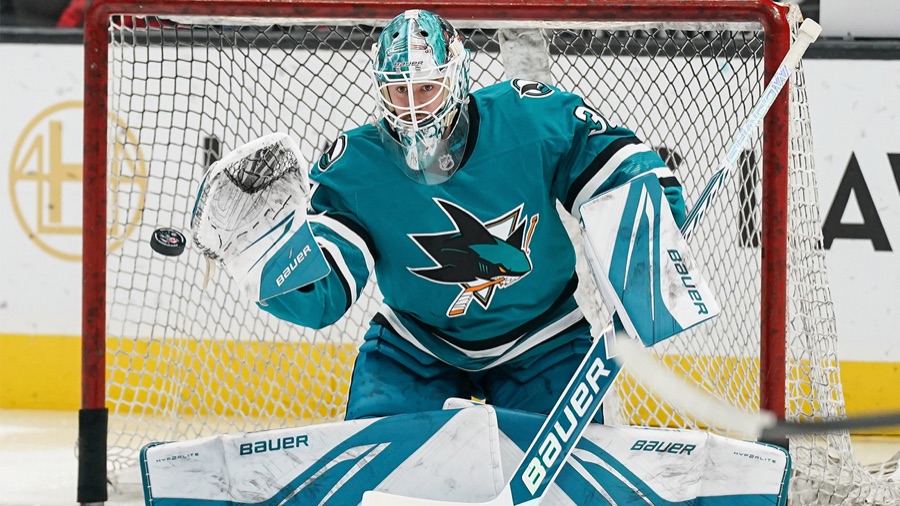
The Michael Kesselring deep dive: the 0-2-2 that lies, and the top-four defenseman underneath it
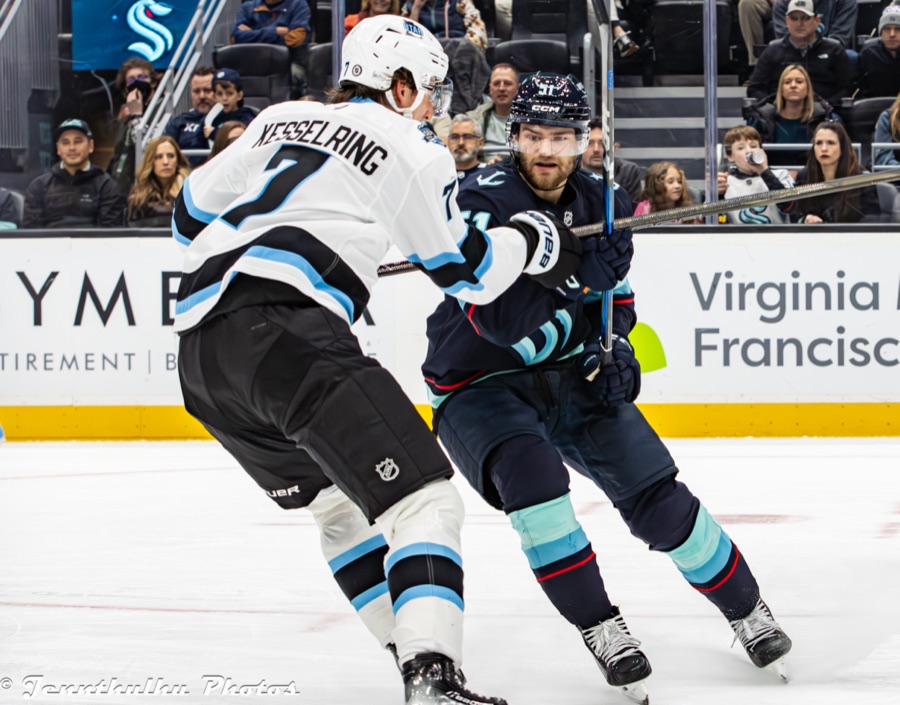
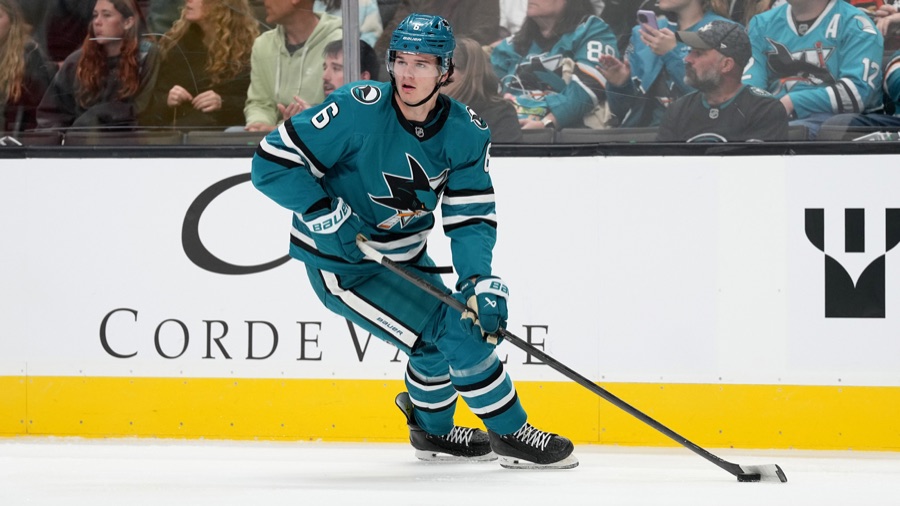
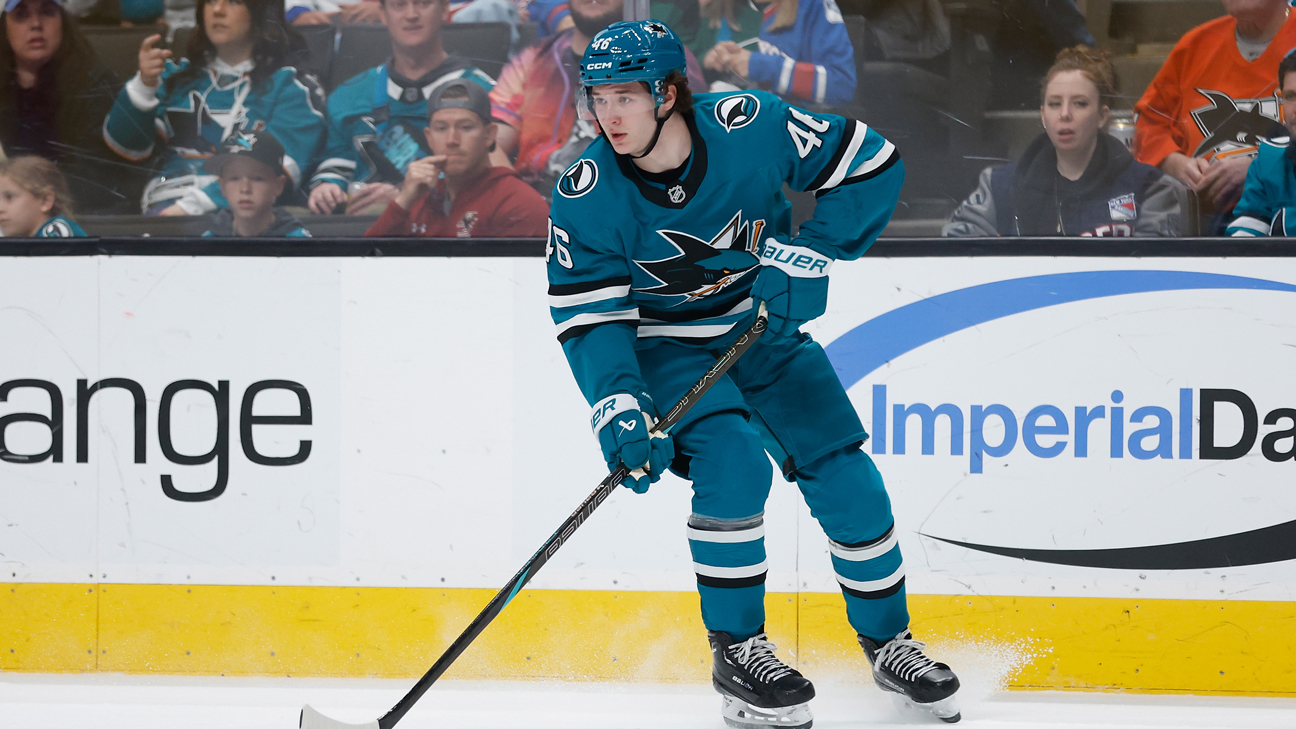
Here is the trap with Michael Kesselring: his most recent stat line reads 34 games, zero goals, two assists, and if you stop there you have learned almost nothing true about the player the Sharks just acquired. The honest scouting job is to figure out which Kesselring is real, the one who put up that line in Buffalo, or the one who, twelve months earlier, controlled high-danger chances at a rate that ranked tenth among every defenseman in the National Hockey League. Spoiler: the evidence points hard at the second one, and the reason the first one exists is a knee and an ankle. Let's go all the way through it.
1. The best year: what Utah saw in 2024-25#
Two seasons ago, on a bad Utah team, Kesselring played all 82 games and had the breakout that made him a trade chip. The counting line was good for a defenseman (7 goals, 22 assists, 29 points, plus-4, 17:41 a night, second-unit power play), but the counting line undersells it. The underlying numbers are where the player lives:
| 2024-25 (Utah), 5-on-5 | Mark | League context |
|---|---|---|
| On-ice high-danger chance share | 56% | 10th in the NHL, the ONLY top-25 D on a non-playoff team |
| On-ice expected-goals share | 53% | 30th among D with 1,000-plus minutes |
| Primary assists at 5-on-5 | 6th among all NHL D | elite distribution from the back end |
| Shot | 2nd-hardest in the NHL | behind only Tage Thompson |
Read the top row twice. Controlling 56 percent of the high-danger chances on a non-playoff team is a top-pairing impact number, and he was the only player in the league's top 25 doing it without a good team around him. Add a top-two shot in the entire sport and a sixth-place finish in primary assists among all defensemen, and the 2024-25 Kesselring was not a "nice depth piece." He was a legitimate top-four right-shot defenseman having the year that gets you traded as the centerpiece of a deal for a 23-year-old scorer (JJ Peterka). He also played a 15-minute-a-night shutdown role on Team USA's World Championship gold team, the first US gold in 92 years. That is the ceiling, and it is not a projection. It is a thing he did.
2. Why last year was bad, and why he sat in the playoffs#
Then he went to Buffalo, and it fell apart. The temptation is to call it a decline. It was an injury report. He played next to Owen Power in training camp, the exact young-offensive-partner role Buffalo acquired him for, and then hurt his knee and missed the start of the season. He came back and sustained a high-ankle sprain that nagged him for months, the kind of injury that quietly ruins a defenseman's skating and edges without ever landing him on long-term injured reserve. By the time he was finally healthy, the depth chart had moved on without him: Zach Metsa had emerged, and Buffalo went out and added Logan Stanley and Luke Schenn. A healthy, in-form Kesselring would have been ahead of those names. An ankle-hobbled one who had missed half the season was not, and a coach in a playoff race plays the guys who are right, not the guy who used to be. He finished with 34 games, was the ninth defenseman by the postseason, and played one playoff game for under five minutes.
The advanced card from that Buffalo year actually confirms the injury read rather than contradicting it. His ratings were modestly below average (38th-to-40th percentile net, offense, and defense), not catastrophic, and he generated 1.68 individual expected goals while scoring zero, which is finishing variance on a tiny sample, not a player who forgot how to play. That is the signature of a hurt, buried defenseman, not a broken one. The zero goals is the number that lies; the still-roughly-functional underlying play is the number that tells the truth.
3. The player he is, and how he got here#
Worth knowing who you are betting on. Kesselring is a 26-year-old, 6-foot-5 right shot who skates, which is one of the rarest archetypes in hockey and exactly the body type Mike Grier has always coveted. He is also a self-made player: a sixth-round pick out of New Hampshire prep, a 5-foot-9 freshman who kept growing, two years of junior (where a coach called him "a bit of a lost soul" and "an offenseman" with too much risk in his game), two years at Northeastern, 141 games in the AHL. He did not play a full NHL season until he was 24. Every stop added a layer: Fargo simplified his defensive reads, Arizona added the nastiness and physicality in his own end that turned him from an offense-only project into a two-way defenseman. The book on him off the ice is uniform: rink rat, relentless work ethic, humble, coachable. Unlike some veterans we have discussed lately, those intangibles sit on top of real, current, measurable ability rather than standing in for its absence. That distinction matters.
4. What the Sharks can expect in 2026-27#
The bet is straightforward: a healthy Kesselring in a soft landing spot reverts toward the Utah form. Two things make that likelier here than the bare odds suggest. First, the injuries were acute and finite (a knee, an ankle), not chronic or age-related, and "get healthy" is a far more bettable fix than "reverse a decline." Second, San Jose offers the opposite of Buffalo's situation: where the Sabres had a deep, cutthroat blue line that buried him the moment he faltered, the Sharks have a barren right side that will hand him a real, stable role and the runway to play through a slow start. Professor Hockey's read, and he likes this trade unreservedly, is that Kesselring "may very well be the Sharks' current best right-handed defenseman" the day he walks in. Expect a genuine top-four trial: 18 to 20 minutes a night, penalty-kill work, and given that second-hardest-shot-in-the-league cannon, a real case for power-play time. The realistic 2026-27 projection is a 25-to-35-point, positive-possession, big-minutes two-way defenseman. The downside, if the Buffalo version is somehow the real one, is a serviceable depth righty, which is a floor, not a disaster.
5. The contract, and the value#
He is a restricted free agent with arbitration rights, on the heels of a two-year, $1.4M deal, and the down year did the Sharks a favor on price.
AFP Analytics had him projected at roughly $4.25M over four years last summer; after the injured season, that fell to about $2.86M. Fear the Fin pencils $3M to $3.5M over four years. The working assumption is around $3M for three or four years, with the Sharks holding real leverage as the team that controls his rights and with arbitration framing the number. So the full price of acquiring a player who was a top-four defenseman 18 months ago is: a seven-spot first-round slide (about a mid-second-round pick of value), no prospect, and roughly $3M a year. The injury that wrecked his counting stats also suppressed his contract. The Sharks are buying the dip on both.
6. Who he fits with: the Owen Power pairing, transplanted#
This is the part the Buffalo trade actually answers for us. The Sabres acquired Kesselring specifically to play alongside Owen Power, a young, mobile, offensively gifted left-shot defenseman, with Kesselring as the steady two-way complement who lets the young stud roam. That pairing never got a real run because of the injuries. But the template is the point, because the Sharks have their own Owen Power, and his name is Sam Dickinson.
| Left-shot partner | The fit with Kesselring |
|---|---|
| Sam Dickinson (the pick) | The Power analog. Kesselring's two-way reliability and defensive conscience free the young offensive stud to attack, exactly the pairing Buffalo drew up. Maximizes both players, and if no top-pair veteran arrives, this is the de facto top pair. |
| Luca Cagnoni | The insulation play. Kesselring's 6-5 frame covers the 5-9 puck-mover, the Carolina model (small offensive D shielded by size). A strong third-pair fit that makes Cagnoni's promotion viable. |
| Dmitry Orlov | Workable but not ideal. The pairing data warned against putting Orlov with a second puck-mover (the Klingberg failure, 42% goals-for); Kesselring is more two-way than Klingberg, but Orlov's best partner was Mukhamadullin. |
| Shakir Mukhamadullin | Redundant. Two defense-leaning bodies; little offensive juice. A depth-pair option, not a first choice. |
The cleanest answer: pair him with Dickinson and run the exact partnership Buffalo wanted, with the Sharks' own franchise lefty in the Power role. A 6-5 two-way right shot with a cannon next to a mobile, offensive 6-3 young stud is a real, balanced top-four pairing, and it is the deployment that gets the most out of both. The fallback, if the Sharks land a top-pair veteran (Carlson, Hamilton, or the new name to watch, Simon Nemec) to slot next to Dickinson, is Kesselring insulating Cagnoni on a genuinely dangerous third pair. Either way, his size is also the quiet enabler of the whole blue line: it is what lets the Sharks carry the small puck-movers (Orlov, Cagnoni) without getting bullied, the same way Carolina insulated Gostisbehere and Walker behind bigger bodies.
7. What it means for the draft and the roster build#
- The No. 2 pick does not change. If anything, Kesselring makes Reid cleaner. Kesselring is a 26-year-old bridge filling the second-pair right side; Reid is the franchise top-pair right shot the contention window needs in 2028 and beyond. They are complementary, not redundant. Acquiring Kesselring removes the temptation to reach for an immediate-impact defenseman at No. 2, which means the Sharks can take the best long-term player with zero positional pressure. That player is Reid.
- No. 27 is now a live chip. The pick came back in this trade, and Professor Hockey reads the nine-days-early timing as a sign Grier may not be done, possibly packaging No. 27 plus assets for a second defenseman (Hronek, or the intriguing younger option, Nemec). Whatever happens, the right-shot need is partly filled, so No. 27 carries no positional pressure: pure best-player-available, or another trade-down.
- The right-side timeline now has a spine. 2026-27: Kesselring (second pair, ~$3M) plus a still-needed top-pair veteran, with Pohlkamp as depth and Havelid in the AHL. 2028-29: Reid arrives as the long-term No. 1. Kesselring at three-to-four years is precisely the bridge that holds the second-pair right side until and alongside Reid, and his deal expires into or just past the 2027 cap crunch as a small, manageable number. He fits the timeline as cleanly as the cap.
The verdict#
A recently-elite, injury-discounted, hard-shooting right-shot defenseman, bought at the bottom for a pick slide and signable at depth money, with a franchise lefty already on the roster to pair him with. This is the buy-low at its best.
The bet is not "can a bad player get good." It is "will a good player get healthy," which is the right bet to make every time you can make it cheaply. The 0-2-2 line is the most misleading number in the Sharks' offseason, and Grier read past it the way you are supposed to. Pair him with Dickinson, give him the power-play look his shot has earned, sign him around $3M, and the Sharks may have found a top-four right-shot defenseman in the bargain bin. The only thing standing between this and an unqualified win is the bounce-back actually landing, and a knee and an ankle that have had a full summer to heal are about the most forgivable reasons a season ever went wrong.
All stats verified: vitals and season lines from the NHL official API (Arizona 5-16-21, Utah 7-22-29, Buffalo 0-2-2); the Utah underlying numbers (56% on-ice HDCF/10th, 53% xGF/30th, 6th in 5v5 primary assists, second-hardest shot) and the injury history from The Athletic (Fairburn); the Buffalo advanced card from Hockey Stat Cards; the contract projections from AFP Analytics via Fear the Fin; the trade terms and grade from Sportsnet, SJHN, and Professor Hockey. Full source trail in docs/2026-offseason/clippings/2026-06-17_TRADE_Kesselring-for-No20-pick-swap.md and the two Professor Hockey clippings. Pairing logic per the blue-line plan's pairing-and-personnel check. The bounce-back and the contract figure are projections; everything else is on the record.